
- Your cart is empty
- Continue shopping
-
Beseha
- Posted on
- Categories:Immunity and Digestion
- 0 comments
The 30-second answer
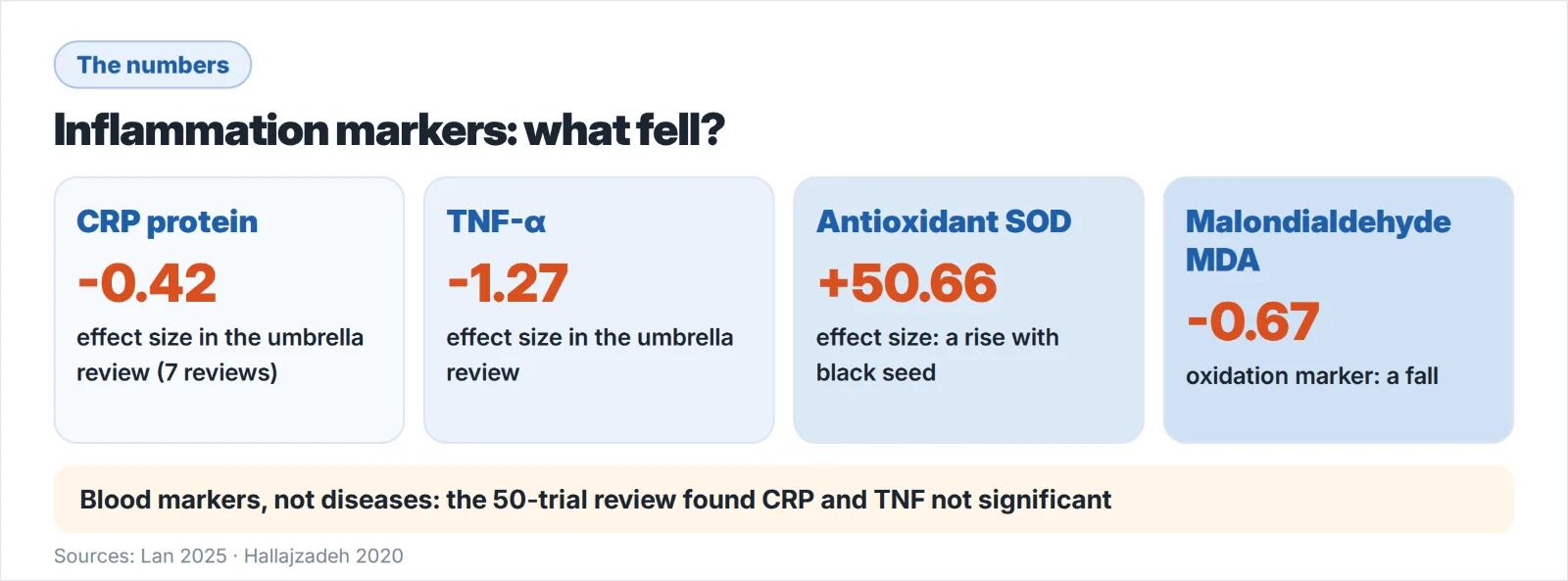
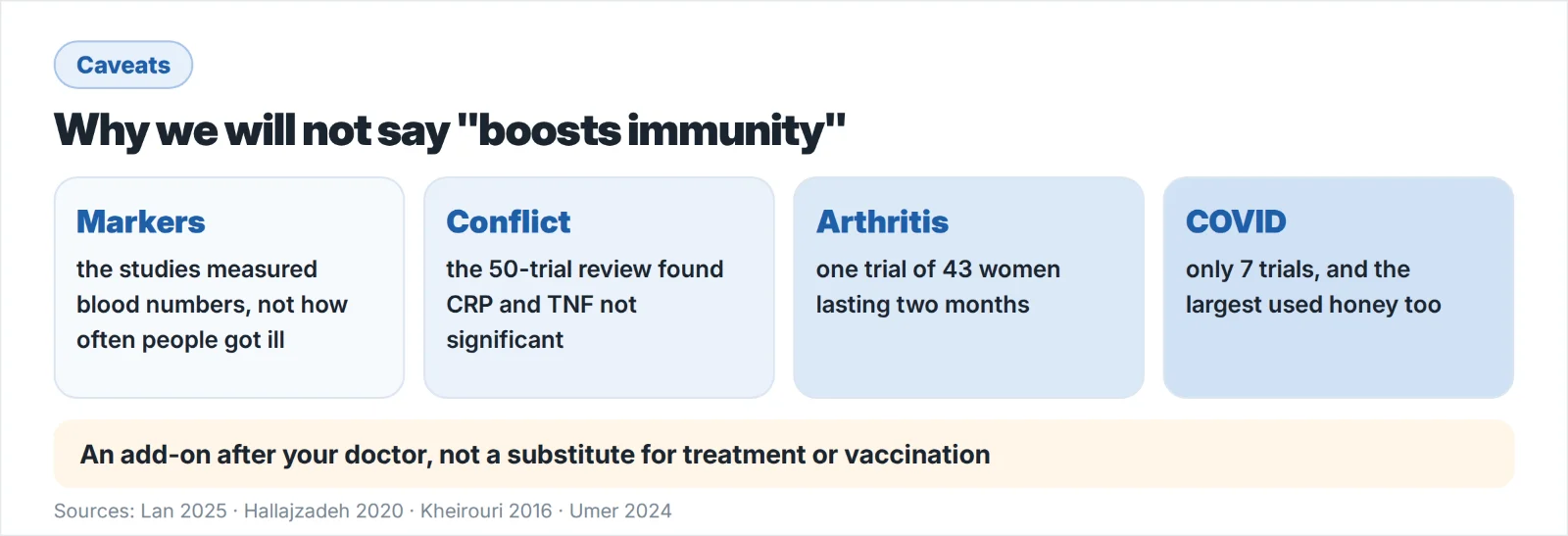
A 2025 umbrella review (7 reviews) found black seed lowered the inflammation markers CRP and TNF-α and raised antioxidants, but a larger 2020 review of 50 trials found CRP and TNF not significant. So the picture is mixed, and what was measured is blood numbers, not how often people got ill. That is why we do not say it “boosts immunity”: it is an add-on after your doctor, not a substitute for treatment or vaccination.
From heritage: the story of the seed and illness
In Sahih al-Bukhari (5687), from Aisha, in the story of treating Ghalib ibn Abjar: «This black seed is a cure for every disease except al-Sam», and when asked what al-Sam is he said «death». Ibn al-Qayyim in Zad al-Ma’ad compared its generality to the verse about the wind, «destroying everything by the command of its Lord», meaning everything that can be destroyed, so the generality is limited to what accepts it. That explains its place in our culture; it is not proof that it strengthens the body’s immunity or treats a particular condition, so what did modern research find?
Inflammation markers: two reviews, two different results
| Study | Type and sample | Result |
|---|---|---|
| Lan 2025 | Umbrella review (GRADE) of 7 meta-analyses, searched to February 2023 | CRP: effect size −0.42 (−0.58 to −0.25); TNF-α: −1.27 (−2.29 to −0.25); MDA: −0.67; TAC: +0.34; SOD: +50.66. The authors described it as an adjuvant anti-inflammatory and antioxidant |
| Hallajzadeh 2020 | Review of 50 randomised trials, searched to October 2019 | CRP: difference −3.61 (−9.23 to 2.01); TNF-α: −1.18 (−3.23 to 0.86); MDA: −0.95 (−2.18 to 0.27); TAC: 0.31 (0.00 to 0.63): all not significant |
- The conflict is real: the umbrella review itself opened by saying earlier reviews had «conflicting results». If someone tells you the numbers are settled, they have not read both reviews.
- Markers, not diseases: CRP and TNF-α are blood numbers; a fall does not mean you will get ill less or that your immunity is better.
- Effect units differ: the table numbers come from the abstracts, and without the full text we do not compare the two reviews’ numbers directly.
Rheumatoid arthritis: one small trial
| Study | Type and sample | Dose and duration | Result |
|---|---|---|---|
| Kheirouri 2016 | 43 women (20 to 50 years) with mild to moderate rheumatoid arthritis, randomised double-blind: 23 black seed and 20 placebo | 1 g oil a day in two doses, for 2 months | Lower hs-CRP and disease activity score DAS-28 and fewer swollen joints versus placebo; lower CD8 cells and higher CD4+CD25+ cells and CD4/CD8 ratio |
This is the clearest trial here that actually measures immune cells, but the sample is only 43 women, it lasted two months, and it was in rheumatoid patients, so it says nothing about healthy people. The authors themselves said it «gives strength to the potential relevance» of the oil in managing the disease, not that it proved it. More on joints in a later article.
COVID: why we do not build on it
| Study | Type and sample | Result |
|---|---|---|
| Umer 2024 | Rapid review of 7 randomised trials in COVID-19 patients | All-cause mortality: risk ratio 0.27 (0.10 to 0.72); PCR positivity: 0.62 (0.39 to 0.97); hospitalisation (0.26) and no recovery (0.48): not significant |
| Ashraf 2023 | 313 patients with moderate or severe COVID-19, 4 centres in Pakistan, randomised placebo-controlled | Honey 1 g/kg with black seed 80 mg/kg a day for up to 13 days on top of usual care: symptoms eased in 4 versus 7 days in moderate cases, and mortality in severe cases was 4% versus 18.87% |
- Hospital patients, not healthy people: these studies are about treating COVID patients on top of usual care, not prevention or everyday immunity.
- The Ashraf trial mixed honey with the seed: we cannot tell black seed’s own share, and the seed was a dose per kilo, not an oil capsule.
- The review said the results are limited by the small number of trials and called for larger ones.
The dose, honestly
- Our capsule holds 1000 mg of oil, and the serving is one capsule. Kheirouri’s dose was 1 g of oil a day for two months, about one capsule a day (split into two).
- The abstracts of the two inflammation reviews give no single dose, so there is no number we can quote for lowering CRP. And the thymoquinone percentage is not on our label, so we do not say our capsule reproduces any study’s result.
- If you try it, one capsule a day for two months after talking to your doctor, and review your tests with them afterwards. Details in black seed oil capsules: dose and timing.
Who should ask a doctor first?
- Anyone with an autoimmune disease or on immunosuppressants or rheumatoid treatment: do not stop your treatment or add anything without your doctor; the Kheirouri trial was on top of patients’ usual treatment.
- People on blood thinners such as warfarin: a lab study predicted an interaction above 1 g of oil a day.
- People on diabetes or blood pressure medicines: sugar and pressure may fall further, so keep monitoring.
- People with kidney or liver disease: rare cases were reported after black seed oil.
- Pregnancy and breastfeeding: there is not enough data, and no proof it increases milk.
- Children: 15 trials found no significant side effects, but the dose is not established and our pack has no child dose; ask the doctor first.
- Skin allergy: black seed oil can cause allergic contact dermatitis; if a rash, swelling or wheeze appears, stop and call the doctor.
Our capsule
#1
1000 mg oilCold-pressed
Avantic Activated Black Seed – 30 Capsules
Virgin black seed oil, one capsule a day
EGP 240
30 capsules · one a day · current price from the product page
- The pack: 1000 mg black seed oil per capsule, one capsule per serving, 30 servings
- The page: cold-pressed virgin oil, made in Egypt and registered with the NFSA under 2024/11149
- The pack: bovine gelatin capsule, only 10 kcal
Heads-up: The thymoquinone percentage is not on the pack, so we will not quote one; the capsule shell is bovine gelatin
Want to ask?
Beseha pharmacists answer on WhatsApp. Tap the “Ask a pharmacist” button and tell them your medicines before you start.
FAQ
Does black seed boost immunity?
None of the studies in this article measured how often healthy people got ill. What was measured is inflammation markers in the blood, and the results conflict between the umbrella review and the 50-trial review, so we do not say it boosts immunity.
Does it lower CRP?
The 2025 umbrella review found a fall in CRP (effect size −0.42), while the 2020 review of 50 trials found it not significant. The result is not settled.
Does it help rheumatoid arthritis?
The Kheirouri trial (43 women, two months, 1 g of oil a day) found lower hs-CRP and disease activity, but it is small, short and an add-on to usual treatment, so keep your treatment as your doctor said.
Does it protect from COVID or the flu?
No; the COVID studies were on hospital patients on top of usual care, the largest mixed honey with the seed, and none shows prevention. It is not a substitute for vaccination.
How many capsules a day?
There is no set dose for immunity; Kheirouri used 1 g of oil a day for two months. Our capsule is 1000 mg and the serving is one capsule, and ask your doctor first.
Who should not take it without a doctor?
People on blood thinners, diabetes or blood pressure medicines, immune or rheumatoid treatment, people with kidney or liver disease, pregnant and breastfeeding women, and children.
Read next: Black seed: what 82 clinical studies show, black seed for allergy and asthma, black seed side effects: who should avoid it and immune supplements: the evidence guide.
The bottom line
The research says black seed may lower some inflammation markers in the blood, but two large reviews disagreed on the result, and the only trial that measured immune cells was small and in rheumatoid patients. So there is no basis to say it “boosts immunity”. It is an add-on after your doctor, not a substitute for treatment or vaccination, and if you take blood thinners, diabetes or blood pressure medicines or immune treatment, ask before you start.
Activated Black Seed at Beseha →
Sources
- Lan and Xia 2025: umbrella meta-analysis of black seed and inflammation and oxidative stress markers
- Hallajzadeh et al. 2020: review of 50 trials on glycaemic control, lipids and inflammation markers
- Kheirouri et al. 2016: black seed oil and T lymphocytes in rheumatoid arthritis
- Umer et al. 2024: Nigella sativa in COVID-19 patients, rapid meta-analysis
- Ashraf et al. 2023: honey and Nigella sativa in COVID-19 (HNS-COVID-PK trial)
- Wang et al. 2022: thymoquinone and warfarin
- Sener et al. 2024: a case of kidney and liver injury after black seed oil
- Abumadini et al. 2025: safety in children, 15 trials
- LactMed 2025: black seed, breastfeeding and skin
- Islamweb: fatwa on using black seed as a remedy (Arabic)
This content is for information and is not a substitute for advice from a doctor or pharmacist. Prices and availability may change; the final price is on the product page.


