
- Your cart is empty
- Continue shopping
-
Beseha
- Posted on
- Categories:Supplements and Vitamins
- 0 comments
The 30-second answer
In studies black seed was mostly well tolerated: a review of 15 pediatric trials found no statistically significant side effects, and the allergic rhinitis review (8 studies) found adverse effects like the control group (OR 1.01). But there are groups who should ask a doctor first: blood thinners such as warfarin, diabetes and blood pressure medicines, kidney and liver disease, pregnancy, breastfeeding and children. Rare cases of kidney and liver problems were reported after black seed oil, as well as skin allergy to the oil.
From heritage: “no disease but…”
In Sahih Muslim (2215) Abu Huraira reports: “There is no disease except that black seed has a remedy for it, except death”. The scholars who explained the hadith did not read it without limits: al-Khattabi called it “a general wording meant for a specific case”, and al-Kirmani said the general meaning holds “on condition it is combined with other things”. So even the classical commentary has conditions and limits, and asking people with expertise. What did modern research say about safety?
What did studies record?
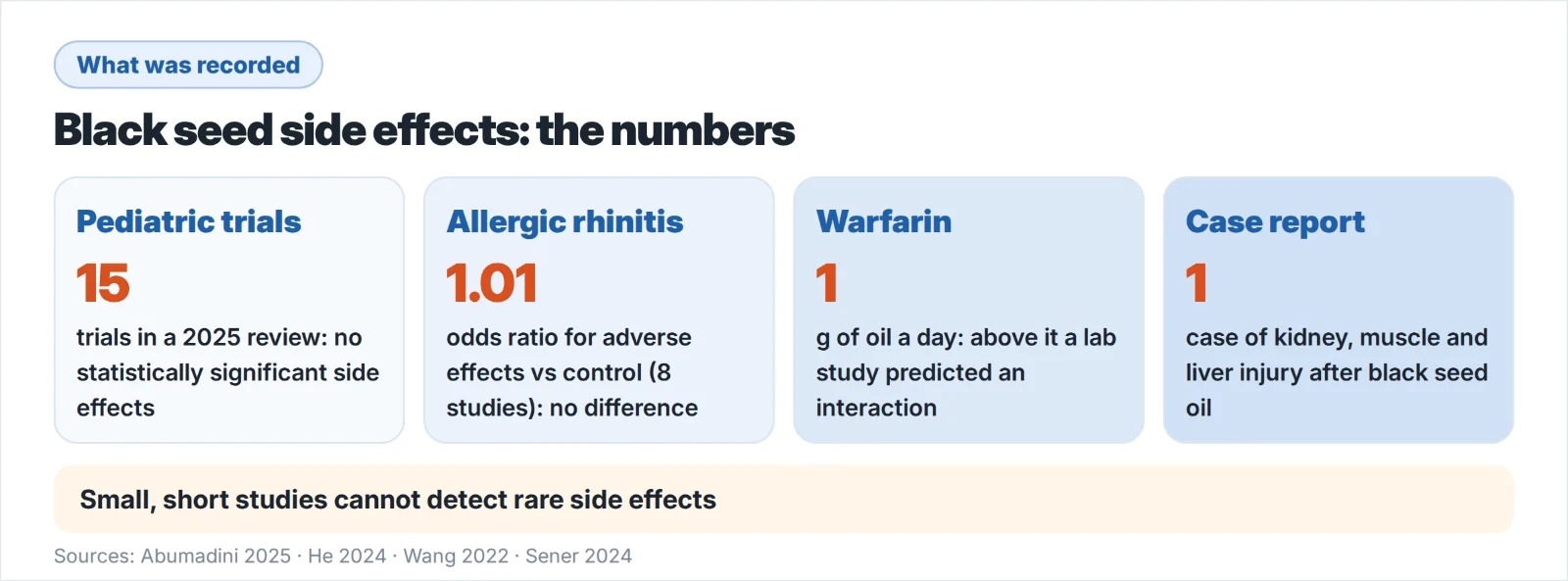
- Children: a 2025 review of 15 pediatric trials found no statistically significant side effects and no severe ones. But the dose and form are not established.
- Allergic rhinitis: 8 studies; adverse effects occurred in 5 of them, were transient, needed no medical intervention and did not differ from the control (OR 1.01, interval 0.59 to 1.73).
- Knee osteoarthritis: a 2024 review (6 trials) said it was well tolerated with no serious adverse events.
- Weight: a 2018 review (11 studies) found no serious side effects.
- Kidney and liver problems: a 2024 case report described muscle breakdown, acute kidney injury and liver toxicity after black seed oil, and said black seed oil should be considered when diagnosing these conditions. Another case report from 2013 is titled acute renal failure associated with Nigella sativa in a diabetic patient (we only verified the title).
- A case is not a rate: these reports are rare and say the topic deserves attention, not that it happens to everyone.
Interactions with medicines
- Warfarin: a 2022 lab study found thymoquinone (the main compound in black seed oil) inhibits the enzyme that breaks down warfarin (IC50 11.35 micromolar). It predicted that black seed oil supplements above 1 g a day could affect warfarin. This is lab data, not human, but anyone on blood thinners should ask their doctor. Our capsule has 1000 mg, exactly on that line, and two capsules would cross it.
- Diabetes and blood pressure medicines: reviews on sugar and blood pressure found black seed lowers them, so with a medicine they could drop further; keep checking your readings with your doctor.
- No large review covers interactions comprehensively, so the list of important medicines is incomplete, which is reason enough to ask.
Pregnancy, breastfeeding, children and skin
- Breastfeeding: LactMed (updated July 2025) says no scientifically valid clinical trials support using it to increase milk, there are no data on excretion of its components into milk or on safety in infants, and that it is generally well tolerated.
- Pregnancy: our sources have not enough data, so ask the doctor first.
- Children: 15 trials found no significant side effects, but dose and form are not established and the product page has no child dose, so ask the doctor first.
- Skin: LactMed says black seed oil can cause allergic contact dermatitis, and Contact Dermatitis report titles name thymoquinone as the allergen, five new cases, and a DRESS syndrome case after topical use of the oil (we verified the titles only).
What is not known
- Long term: studies ran from 1 to 48 weeks only, so we do not say it is safe for years.
- Strength: the thymoquinone percentage is not on the product label, so we will not quote one.
- Product quality: LactMed warns supplements may differ from the label, and results on one product may not apply to another.
Who should ask a doctor first?
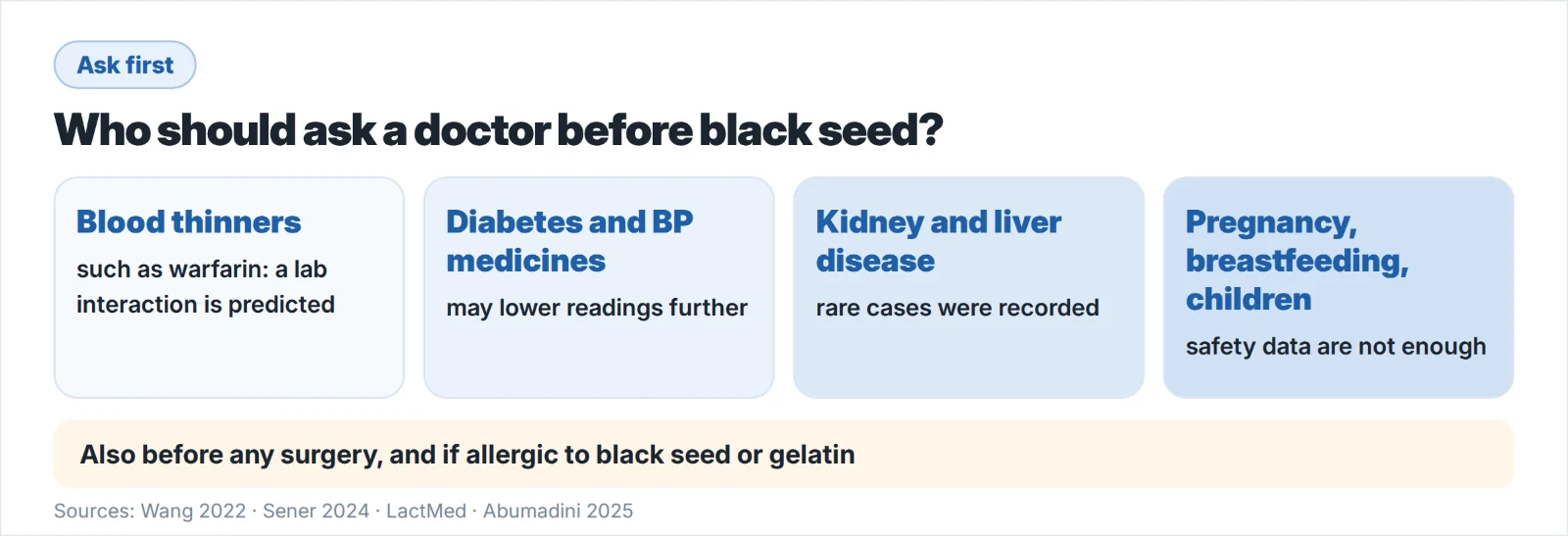
- People on blood thinners such as warfarin: a lab study predicted an interaction above 1 g of oil a day.
- People on diabetes or blood pressure medicines: readings may drop further, so keep checking them.
- People with kidney or liver disease: rare cases of kidney and liver problems were reported after black seed oil.
- Pregnancy, breastfeeding and children: safety data are not enough.
- Anyone with skin allergy or allergy to black seed or gelatin, and before any surgery.
- If you develop unusual symptoms while taking black seed oil, tell your doctor you take it.
Our capsule
#1
1000 mg oilCold-pressed
Avantic Activated Black Seed – 30 Capsules
Virgin black seed oil, one capsule a day
EGP 240
30 capsules · one a day · current price from the product page
- The pack: 1000 mg black seed oil per capsule, one capsule per serving, 30 servings
- The page: cold-pressed virgin oil, made in Egypt and registered with the NFSA under 2024/11149
- The pack: bovine gelatin capsule, only 10 kcal
Heads-up: The thymoquinone percentage is not on the pack, so we will not quote one; the capsule shell is bovine gelatin
The dose and duration in detail are in black seed oil capsules: dose and timing. The main safety steps: follow the serving on the pack (one capsule), do not combine it with another black seed product, and tell your doctor or pharmacist everything you take.
Want to ask?
Beseha pharmacists answer on WhatsApp. Tap the “Ask a pharmacist” button and tell them which medicines you take before you start.
FAQ
What are the side effects of black seed?
A review of 15 pediatric trials and an allergic rhinitis review found adverse effects no different from controls, but rare cases of kidney injury and liver toxicity were reported after black seed oil, as well as skin allergy to the oil.
Who should avoid black seed?
We do not say avoid, but people on blood thinners, diabetes or blood pressure medicines, people with kidney or liver disease, pregnant and breastfeeding women, children and anyone with allergy should ask a doctor first.
Does black seed interact with warfarin?
A 2022 lab study predicted a possible interaction with black seed oil above 1 g a day; it is not human data, but ask your doctor.
Is black seed safe in pregnancy and breastfeeding?
There are not enough data; LactMed says there are no data on excretion into milk or on infant safety, and no proof it increases milk.
Can it harm the kidneys or liver?
Rare cases of kidney injury and liver toxicity were reported after black seed oil in case reports; that does not mean it happens to everyone who takes it.
Can I take it for years?
There are no data; trials ran from 1 to 48 weeks only.
Read next: Black seed: what 82 clinical studies show and black seed oil capsules: dose and timing.
The bottom line
Black seed was well tolerated in short studies, but some groups should ask a doctor first: blood thinners, diabetes and blood pressure medicines, kidney and liver disease, pregnancy, breastfeeding and children. The long term was not studied, so follow the serving on the pack and check with your doctor.
Activated Black Seed at Beseha →
Sources
- Abumadini et al. 2025: Nigella sativa in pediatrics, safety review
- He et al. 2024: Nigella and allergic rhinitis
- Mousavi et al. 2024: Nigella sativa and knee osteoarthritis
- Namazi et al. 2018: Nigella sativa and weight
- Wang et al. 2022: thymoquinone and warfarin
- Sener et al. 2024: case report, kidney injury and liver toxicity after black seed oil
- Arslan et al. 2013: case report, renal failure (title only)
- LactMed: Black seed
- Kurihara et al. 2020: thymoquinone as a contact allergen (title only)
- Seiller et al. 2021: five new allergy cases (title only)
- Fargeas et al. 2022: DRESS after topical use (title only)
- Jafari et al. 2025: 82 studies on black seed
- Islamweb: fatwa on using black seed as a remedy (Arabic)
This content is for information and is not a substitute for advice from a doctor or pharmacist. Prices and availability may change; the final price is on the product page.


