
- Your cart is empty
- Continue shopping
-
Beseha
- Posted on
- Categories:Immunity and Digestion
- 0 comments
The 30-second answer
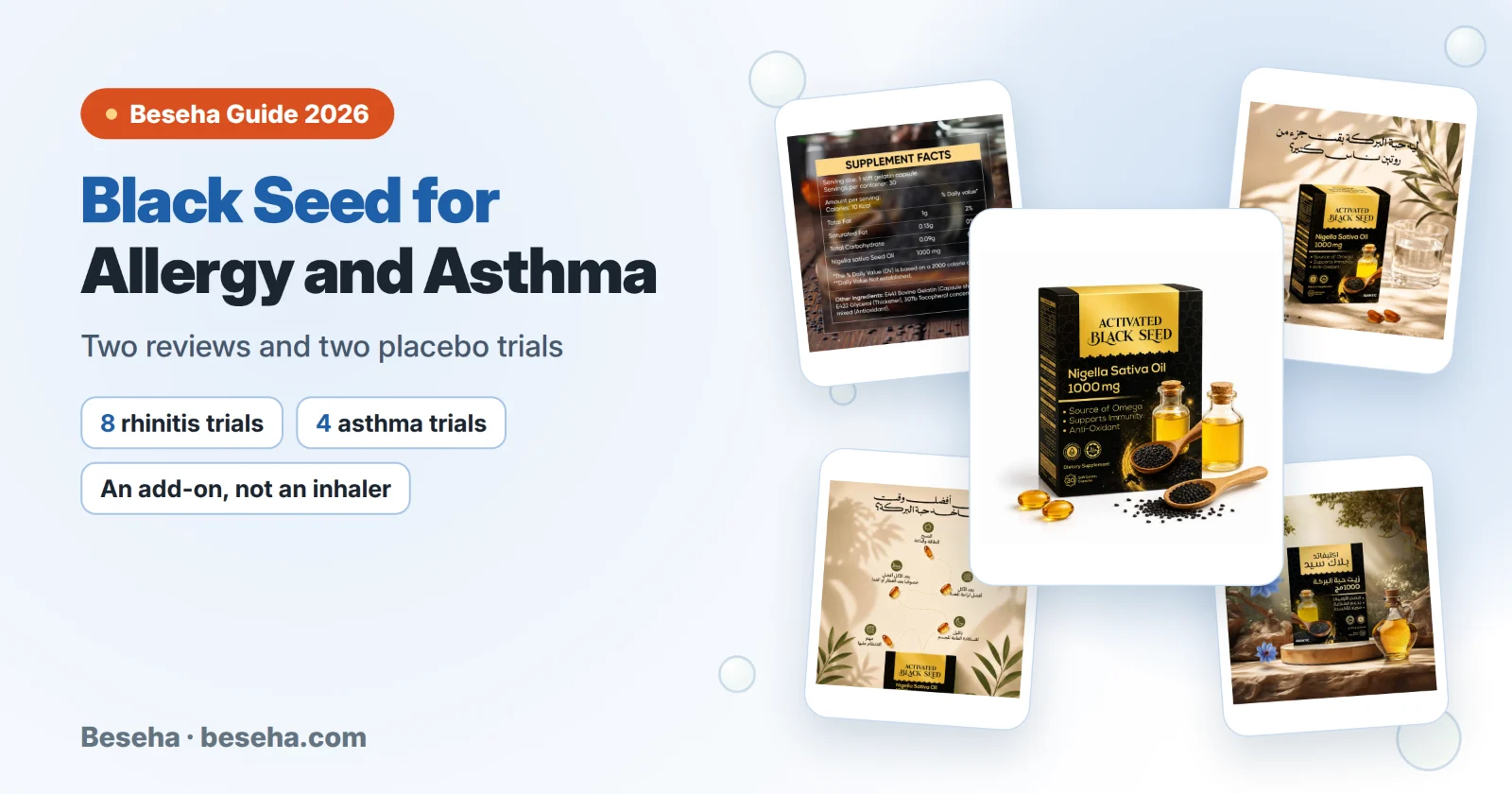
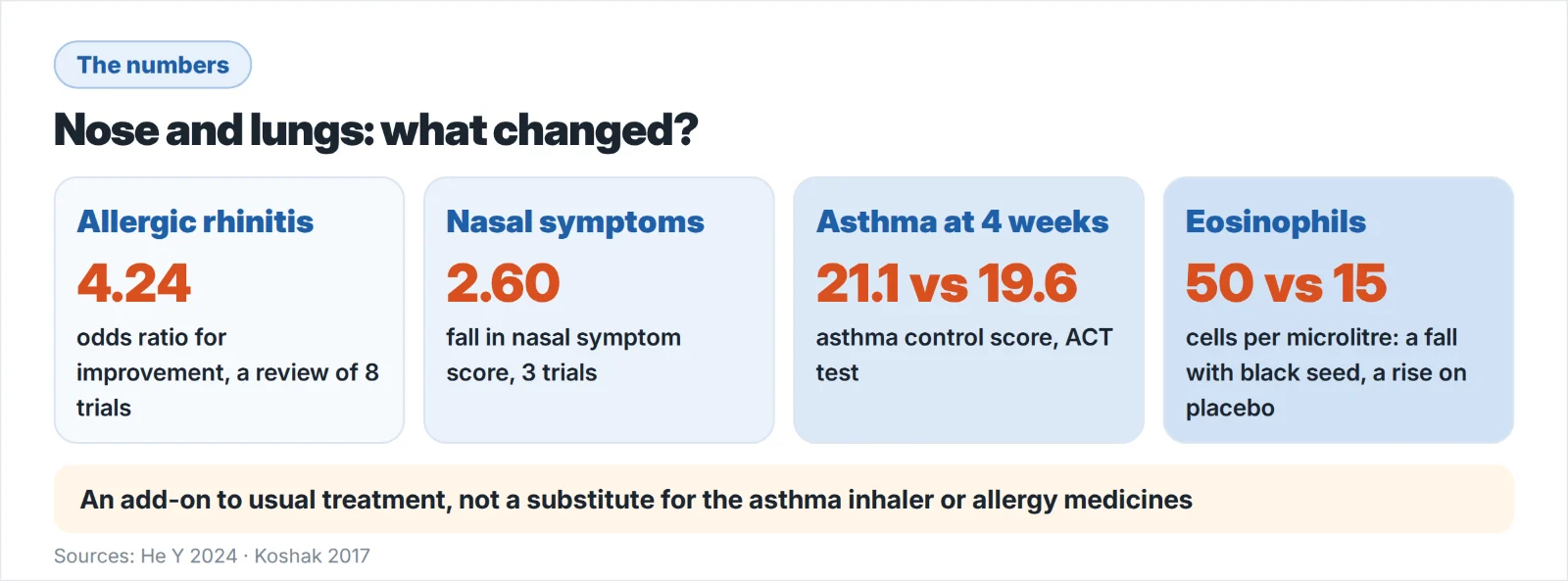
A 2024 review (8 randomised trials) found black seed improved allergic rhinitis symptoms more than placebo (odds ratio 4.24), but the trials are small and of lower quality. In asthma, the 2017 Koshak trial (80 patients, 1 g a day for 4 weeks on top of usual treatment) improved the asthma control score (21.1 vs 19.6) and lowered eosinophils, but the FEV1 breathing test did not improve significantly. It is an add-on after your doctor, not a substitute for the asthma inhaler or allergy medicines.
From heritage: the seed in the narrations on medicine
The narration in Muslim (2215) reads «There is no disease but black seed holds a remedy for it, except death». The scholars differed over how general it is: in al-Ayni’s commentary (Umdat al-Qari) Ibn Abi Hamza kept the general meaning, while al-Khattabi and al-Kirmani restricted it. An Islamweb fatwa says it is a remedy, not an act of worship, and that its use is referred to experienced doctors. That explains its place in our culture; it is not a promise of a result in a specific condition such as allergy or asthma, so what did modern research find?
Allergic rhinitis: what did the trials find?
| Study | Type and sample | Dose and duration | Result |
|---|---|---|---|
| He Y 2024 | Review of 8 randomised trials | Various doses | Odds ratio for overall improvement 4.24 (2.57 to 7.27); nasal symptom score lower by a mean difference of 2.60 in 3 trials; transient adverse effects did not differ from placebo (odds ratio 1.01) |
| Majeed 2024 | 65 adults, randomised double-blind placebo-controlled | 250 mg oil with 2.5 mg piperine twice daily (500 mg oil a day) for 15 days | Nasal and eye symptom scores lower than placebo; IgE fell but not significantly versus placebo |
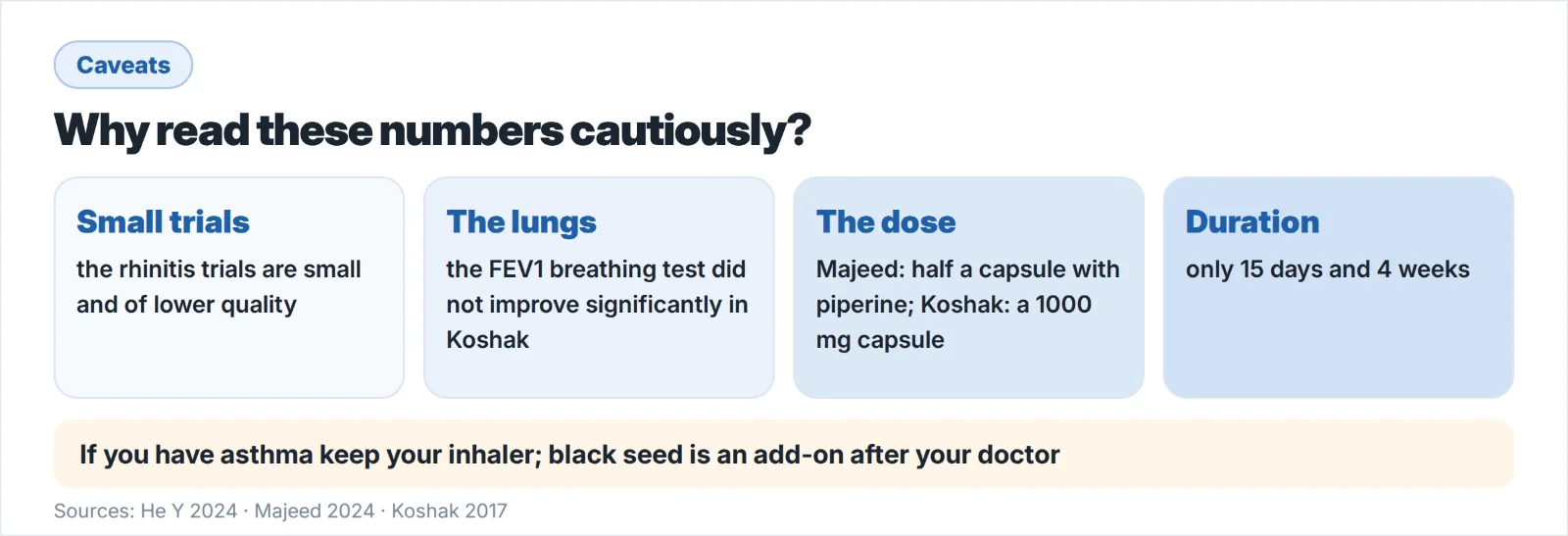
- The review’s own caveat: the authors said the small number of trials and weaker design may affect how stable the result is, and called for larger multicentre trials.
- The Majeed trial used a different product: a standardised oil with 5% thymoquinone plus piperine, and the authors are employees of the company that markets it, so it is not our capsule.
- Short: 15 days in the Majeed trial, so nothing is known about use beyond that.
Asthma: an add-on to usual treatment
| Study | Type and sample | Dose and duration | Result |
|---|---|---|---|
| Koshak 2017 | 80 asthma patients (40 each), randomised double-blind, and 10 in each group withdrew | 500 mg oil twice daily (1 g a day) for 4 weeks, on top of usual treatment | Asthma Control Test (ACT) 21.1 versus 19.6; blood eosinophils fell by 50 cells/microlitre versus a rise of 15 on placebo; FEV1 improved 4 versus 1 but not significantly |
| He T 2020 | Review of 4 randomised trials | Various doses | ACT: standardised mean difference 0.50 (0.11 to 0.88); FEV1: 1.84 (0.07 to 3.60); peak expiratory flow, IL-4 and IFN-γ not significant |
The Koshak trial used black seed as a supplementary treatment for asthma; the clearest result was in the control score and eosinophils, with only a “trend” in lung function (not significant). The authors themselves asked for longer follow-up in a multicentre trial.
The dose, honestly
- Our capsule holds 1000 mg of oil, and the serving is one capsule. Koshak’s dose was 1 g a day, about one capsule a day (split into two).
- Majeed’s dose was 500 mg of oil a day with piperine, about half a capsule, but their product is standardised to 5% thymoquinone, and our label does not state a thymoquinone percentage, so we do not say our capsule reproduces the result.
- The trials were short (15 days and 4 weeks). If you try it, take one capsule a day after talking to your doctor and review your symptoms with them after a month. Details in black seed oil capsules: dose and timing.
Who should ask a doctor first?
- Anyone with asthma: keep your inhaler and medicines as your doctor said; the Koshak trial was an add-on to usual treatment, not a substitute.
- People on blood thinners such as warfarin: a lab study predicted an interaction above 1 g of oil a day, and Koshak’s dose is at that line.
- People on diabetes or blood pressure medicines: sugar and pressure may fall further, so keep monitoring.
- People with kidney or liver disease: rare cases were reported after black seed oil.
- Pregnancy and breastfeeding: there is not enough data, and no proof it increases milk.
- Children: 15 trials found no significant side effects, but the dose is not established and our pack has no child dose; ask the doctor first.
- Skin allergy: black seed oil can cause allergic contact dermatitis; if a rash, swelling or wheeze appears, stop and call the doctor.
Our capsule
#1
1000 mg oilCold-pressed
Avantic Activated Black Seed – 30 Capsules
Virgin black seed oil, one capsule a day
EGP 240
30 capsules · one a day · current price from the product page
- The pack: 1000 mg black seed oil per capsule, one capsule per serving, 30 servings
- The page: cold-pressed virgin oil, made in Egypt and registered with the NFSA under 2024/11149
- The pack: bovine gelatin capsule, only 10 kcal
Heads-up: The thymoquinone percentage is not on the pack, so we will not quote one; the capsule shell is bovine gelatin
Want to ask?
Beseha pharmacists answer on WhatsApp. Tap the “Ask a pharmacist” button and tell them your medicines before you start.
FAQ
Does black seed help allergic rhinitis?
A 2024 review of 8 trials found better symptoms than placebo (odds ratio 4.24), but the trials are small and of lower quality, so the result is preliminary.
Does it replace the asthma inhaler?
No; the Koshak trial used it as an add-on to usual treatment, so keep your medicines as your doctor said.
How many capsules a day for allergy or asthma?
There is no set dose; Koshak used 1 g of oil a day for 4 weeks and Majeed 500 mg a day with piperine for 15 days. Our capsule is 1000 mg and the serving is one capsule, and ask your doctor first.
Does it improve lung function?
In Koshak the FEV1 test improved 4 versus 1 but not significantly, and the 2020 review showed a difference in FEV1 with wide variation between trials (a wide confidence interval).
Does it have side effects?
In the rhinitis review the effects were transient and did not differ from placebo. Rare cases of kidney and liver injury were reported after the oil, and the oil can cause allergic contact dermatitis.
Is it suitable for children with allergy or asthma?
A review of 15 trials found no significant side effects, but the dose is not established and our pack has no child dose, so the child’s doctor comes first.
Read next: Black seed: what 82 clinical studies show, black seed side effects: who should avoid it and black seed and weight loss.
The bottom line
The trials point to better allergic rhinitis symptoms and asthma control with black seed, but they are small and short, and the lung test did not improve significantly. It is an add-on after your doctor, not a substitute for the inhaler or allergy medicines, and if you take blood thinners or diabetes or blood pressure medicines, ask before you start.
Activated Black Seed at Beseha →
Sources
- He Y et al. 2024: Nigella sativa for allergic rhinitis, meta-analysis of 8 trials
- Majeed et al. 2024: standardised 5% thymoquinone oil in seasonal allergy
- Koshak et al. 2017: Nigella sativa and asthma control
- He T and Xu X 2020: Nigella sativa for asthma control, meta-analysis
- Wang et al. 2022: thymoquinone and warfarin
- Sener et al. 2024: a case of kidney and liver injury after black seed oil
- Abumadini et al. 2025: safety in children, 15 trials
- LactMed 2025: black seed, breastfeeding and skin
- Islamweb: fatwa on using black seed as a remedy (Arabic)
This content is for information and is not a substitute for advice from a doctor or pharmacist. Prices and availability may change; the final price is on the product page.


