
- Your cart is empty
- Continue shopping
-
Beseha
- Posted on
- Categories:Supplements and Vitamins
- 0 comments

The 30-second answer
The largest review so far (2025) pooled 82 studies in 5,026 people and found black seed improved weight, blood pressure, blood sugar, lipids and inflammation markers. The differences are small but real: about 3 mmHg in blood pressure and 21 mg/dL in fasting sugar in people with diabetes. Studies gave it every day for 1 to 48 weeks, so it can be part of your daily routine, alongside your treatment, not instead of it.
Black seed in our heritage
Black seed has long held a special place in our culture. In Sahih al-Bukhari (5688), Abu Huraira reported that he heard the Prophet ﷺ say: “In the black seed there is healing for every disease except death”, and Ibn Shihab explained that the black seed is shuniz. Scholars read “every disease” in different ways: al-Khattabi said it is a general phrase meant specifically, and Ibn al-Qayyim compared it to the verse “destroying everything”, meaning everything that can be affected. An Islamweb fatwa adds that it is a remedy, not an act of worship, and that its use should be left to experienced doctors. So what has modern research found?
What did 82 studies find?
Jafari and colleagues (2025) pooled 82 studies published from 2008 to 2024, with 5,026 participants, doses of 200 to 4,600 mg a day and durations of 1 to 48 weeks. They found improvements in weight and body fat, blood pressure, fasting and long-term blood sugar, cholesterol and triglycerides, inflammation markers and liver enzymes, and called it a “promising adjunct therapy”.
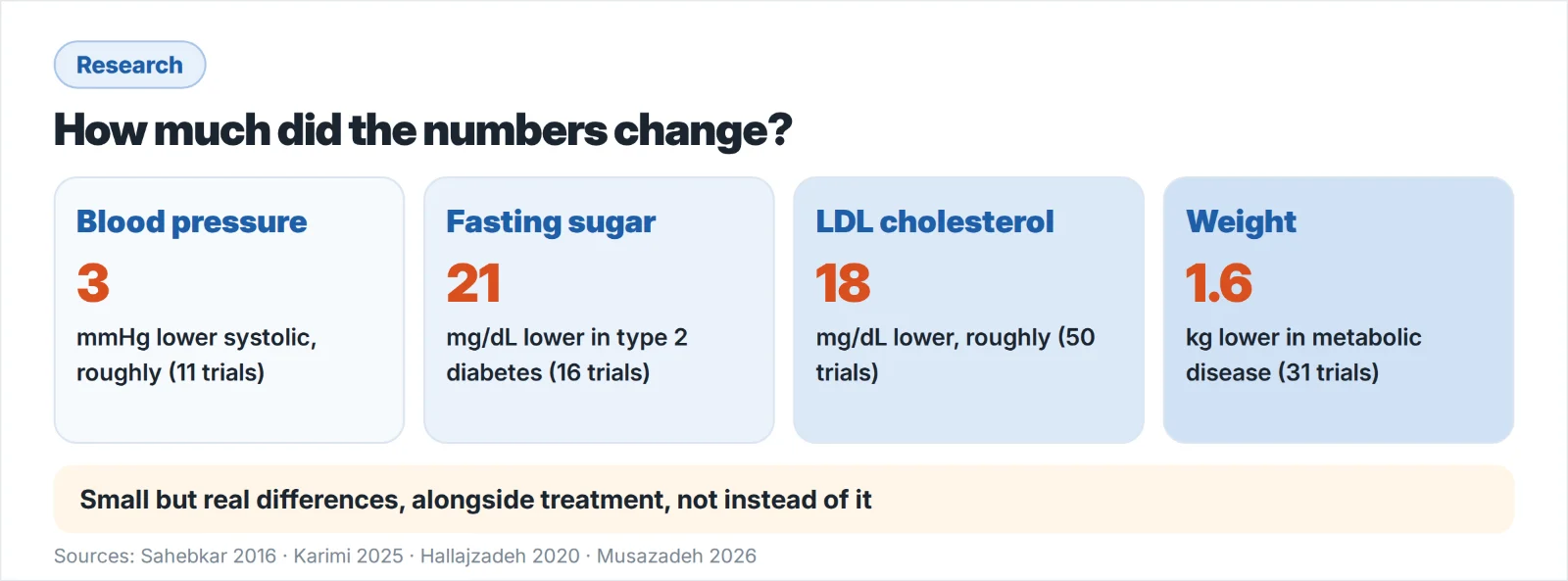
| Area | What research found | Strength |
|---|---|---|
| Blood pressure | Systolic 3.26 mmHg lower, diastolic 2.80 (11 trials, 860 people) | Moderate |
| Blood sugar | In type 2 diabetes: fasting sugar 21.43 mg/dL lower, HbA1c 0.44 (16 trials) | Moderate |
| Lipids | Total cholesterol 16.80 lower, LDL 18.45, triglycerides 15.73 (50 trials) | Moderate |
| Weight | 1.59 kg lower in metabolic disease (31 trials, 2,145 people) | Moderate, small effect |
| Fatty liver | Better fat grade and liver enzymes (5 trials, 358 people) | Limited |
| Nasal allergy | Better response and fewer symptoms; side effects similar to placebo (8 small trials) | Limited |
These are averages across many studies, and some vary a lot between studies. The liver and joint studies that found results used 5 to 7.5 mL of oil a day, far more than one capsule.
How to make it a daily routine
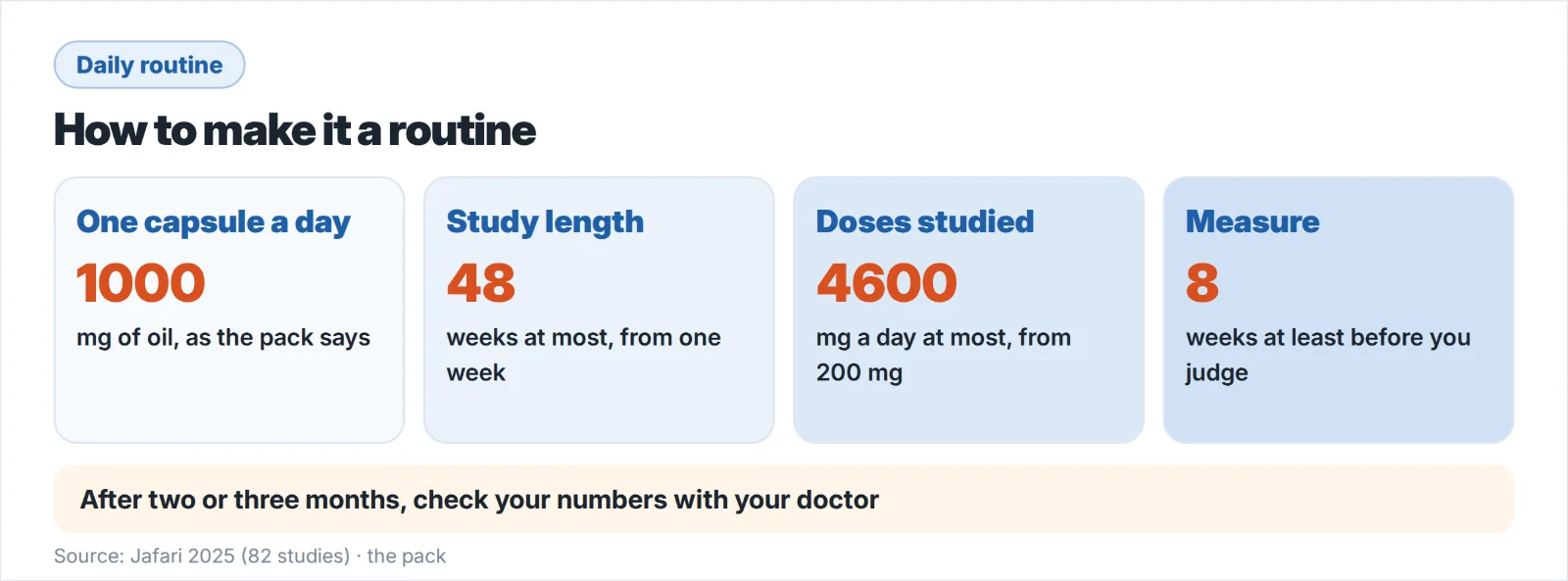
- One capsule a day: as the pack says. The closest study to this dose was in asthma: 500 mg twice a day for 4 weeks improved asthma control scores.
- Give it at least 8 weeks: a 2025 review in diabetes found its effect on fasting sugar was clearer after 8 weeks.
- Measure before and after: test your sugar and lipids and check your blood pressure, then compare with your doctor after two or three months.
- With your diet and activity: black seed helps but does not replace healthy eating. For healthy fats, see fish oil in Egypt.
Black seed capsules at Beseha
#1
1000 mg oilCold-pressed
Avantic Activated Black Seed – 30 Capsules
Virgin black seed oil, one capsule a day
EGP 240
30 capsules · one a day · current price from the product page
- The pack: 1000 mg black seed oil per capsule, one capsule per serving, 30 servings
- The page: cold-pressed virgin oil, made in Egypt and registered with the NFSA under 2024/11149
- The pack: bovine gelatin capsule, only 10 kcal
Heads-up: The thymoquinone percentage is not on the pack, so we will not quote one; the capsule shell is bovine gelatin
Who should ask a doctor first?
- People on blood thinners such as warfarin: a lab study predicted an interaction above 1 g of black seed oil a day.
- People on diabetes or blood pressure medicines: black seed may lower them a little further, so keep checking your readings.
- People with kidney or liver disease: rare cases of kidney and liver problems have been reported after black seed oil.
- Pregnancy, breastfeeding and children: there is not enough safety data, and LactMed says there is no proof it increases milk.
- If you apply the oil to your skin: it can cause allergic contact dermatitis.
Want to ask?
Beseha pharmacists answer on WhatsApp. Tap the “Ask a pharmacist” button and tell them which medicines you take, and they will tell you how to start.
New research
- 2026: a review of 31 trials in 2,145 people with metabolic disease found weight 1.59 kg lower, systolic pressure 3.25 mmHg lower and fasting sugar 18.62 mg/dL lower, with no effect on insulin resistance.
- 2025: the Jafari review (82 studies) is the largest so far, and called it a promising adjunct therapy.
- This section is updated weekly when a new human study is published.
FAQ
What are the proven benefits of black seed?
A 2025 review of 82 studies found small improvements in weight, blood pressure, blood sugar, lipids and inflammation markers; it is an adjunct, not a replacement for medicine.
How many black seed capsules should I take a day?
One 1000 mg capsule a day, as the pack says; studies used 200 to 4,600 mg a day.
When do black seed results show?
Studies usually measured results after 8 weeks or more, so wait two or three months and then repeat your tests with your doctor.
Does black seed lower blood pressure?
A review of 11 trials found systolic pressure 3.26 mmHg and diastolic 2.80 mmHg lower than placebo.
Is black seed safe every day?
Studies gave it daily for up to 48 weeks with mostly mild side effects, but ask a doctor if you take blood thinners, diabetes or blood pressure medicines, or have kidney or liver disease.
What does the hadith about black seed mean?
It is reported by al-Bukhari and Muslim; Ibn Shihab explained al-sam as death, scholars read every disease as diseases that can respond to it, and its use is left to doctors.
Read next: zinc for immunity and the safe dose and fish oil in Egypt.
The bottom line
Black seed is one of the most studied herbs: 82 studies found small improvements in blood pressure, sugar, lipids and weight. To make it a daily routine, take one capsule a day for two or three months, then check your numbers with your doctor. If you take blood thinners, diabetes or blood pressure medicines, ask first.
Activated Black Seed at Beseha →
Sources
- Jafari et al. 2025: 82 studies on black seed and cardiovascular risk factors
- Musazadeh et al. 2026: black seed in metabolic disease
- Sahebkar et al. 2016: black seed and blood pressure
- Karimi et al. 2025: black seed in type 2 diabetes
- Hallajzadeh et al. 2020: black seed, glucose and lipids
- Tang et al. 2021: black seed and fatty liver
- He et al. 2024: black seed and allergic rhinitis
- Koshak et al. 2017: black seed oil and asthma
- Wang et al. 2022: thymoquinone and warfarin
- Sener et al. 2024: kidney and liver injury after black seed oil (case report)
- LactMed: Black seed
- Islamweb: fatwa on using black seed as a remedy (Arabic)
- Umdat al-Qari: chapter on black seed (Arabic)
- Zad al-Ma’ad: black seed (Arabic)
This content is for information and is not a substitute for advice from a doctor or pharmacist. Prices and availability may change; the final price is on the product page.


