
- Your cart is empty
- Continue shopping
-
Beseha
- Posted on
- Categories:General Health
- 0 comments
The 30-second answer
One trial in 120 people with fatty liver (2019) found black seed oil lowered the steatosis grade and liver enzymes more than placebo after 3 months, but at 5 mL of oil a day. A 2021 review (5 trials, 358 patients) found improvement in ALT, AST and fatty-liver grade, and another review (8 trials) found a fall in AST only and not in ALT. This is an improvement in lab values, not a treatment, and it needs a diagnosis and follow-up with your doctor.
From heritage: the shuniz
In Sahih Bukhari (5688), after “In black seed there is a remedy for every disease except death”, Ibn Shihab adds: “death is al-sam, and black seed is the shuniz”. In Zad al-Ma’ad Ibn al-Qayyim likens the “every” here to the verse “destroying everything by the command of its Lord”, meaning everything that can be destroyed, so “every disease” for him means the diseases that respond to it. An Islamweb fatwa says black seed is a remedy, not an act of worship, and that using it is referred to experienced doctors. This is why it holds a place in our culture, not proof that it treats fatty liver. So what did modern research find?
What did the studies find?
| Study | Who and how many | Result |
|---|---|---|
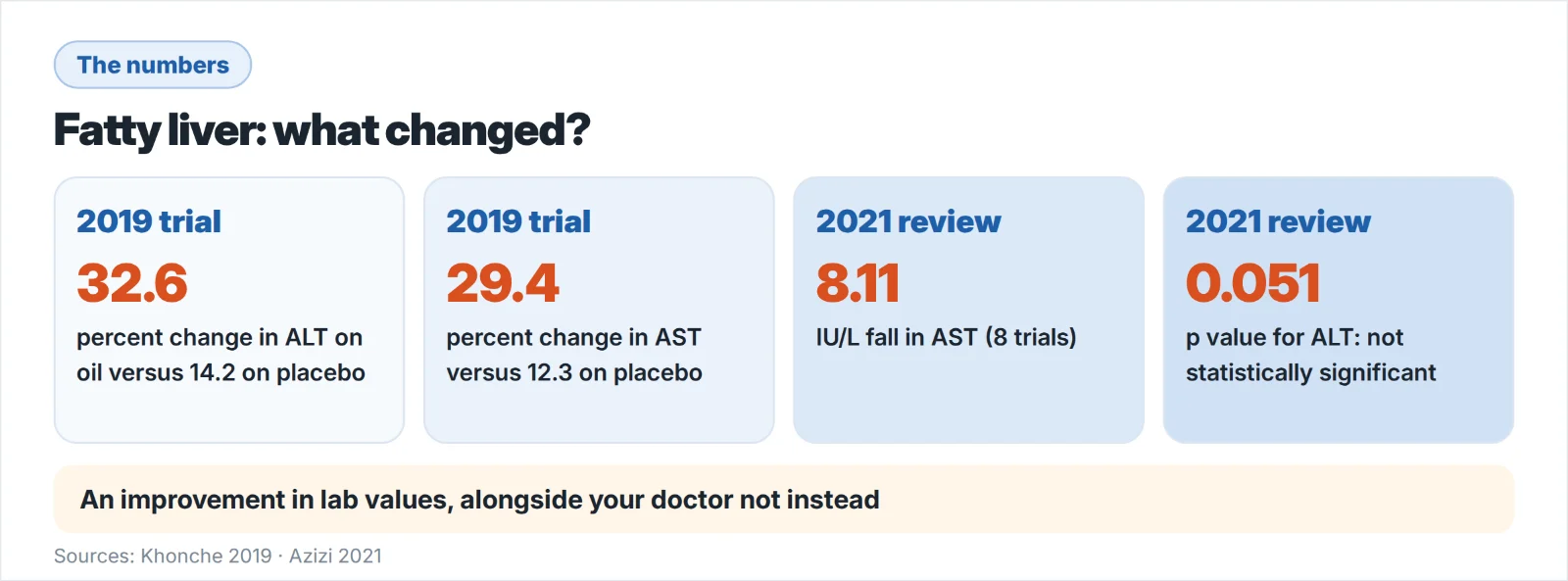
| Khonche 2019 | Double-blind randomised trial: 120 fatty liver patients (60 oil, 60 placebo), 2.5 mL standardised oil every 12 hours for 3 months | The steatosis grade fell more with oil than placebo (p=0.004); the change in ALT was 32.6% versus 14.2%, AST 29.4% versus 12.3%, triglycerides 10% versus 0.22%, LDL 14.1% versus 9.2% and HDL 9.5% versus 4.8%. No adverse effect was observed |
| Tang 2021 | 5 trials (6 articles), 358 fatty liver patients | Improvement in ALT, AST, fasting sugar, HDL, hs-CRP and fatty-liver grade; no change in total cholesterol, LDL, triglycerides, insulin and TNF-α |
| Azizi 2021 | 8 trials: 281 on black seed and 279 on placebo | AST fell 8.11 IU/L (2.53 to 13.6), and ALT fell 7.26 (15.4 fall to 0.04 rise) and was not statistically significant (p=0.051); variation between studies of 95.9% and 97.8% |
| Jafari 2025 | 82 studies, 5,026 participants, doses of 200 to 4,600 mg/day for 1 to 48 weeks | The abstract lists improvement in ALT and AST without pooled numbers |
- Lab values, not the liver itself: ALT and AST point to liver stress, and the 2019 trial also measured the steatosis grade by ultrasound.
- The same direction in 3 sources: one trial and two reviews found improvement in the enzymes or the liver grade, with differences in detail.
- Fats: triglycerides improved in the 2019 trial and did not change in the 5-trial review; for more: black seed and cholesterol.
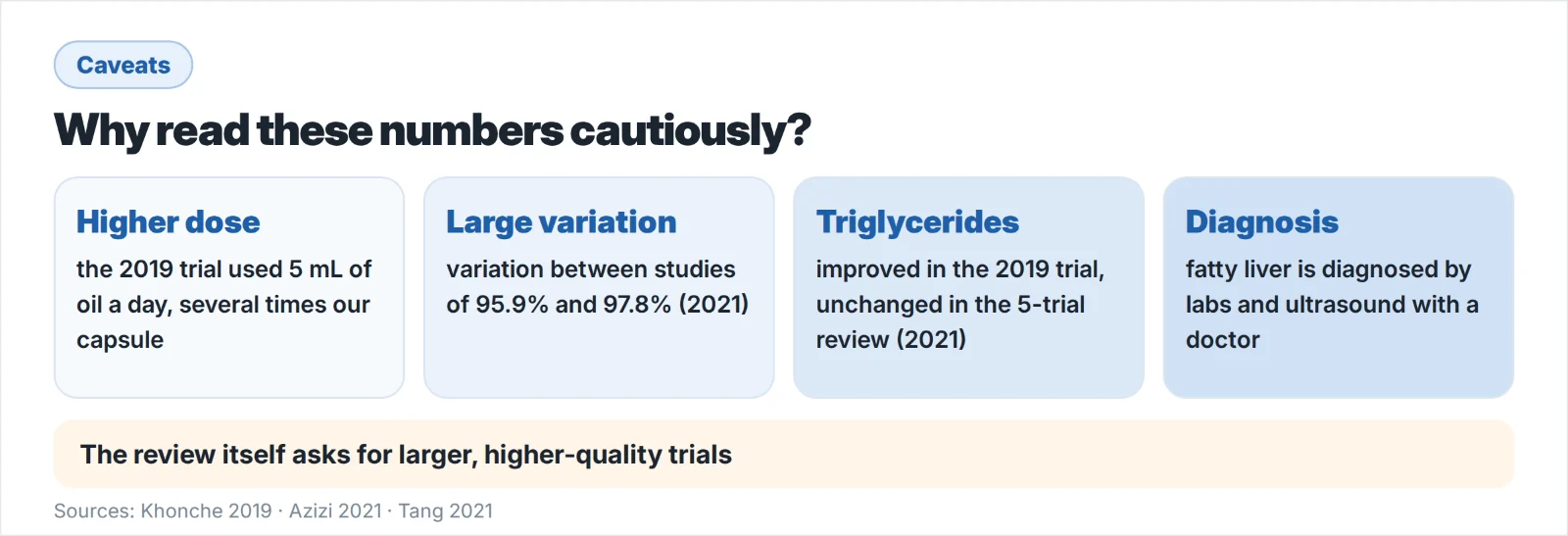
- The review itself is cautious: Tang 2021 said effectiveness was controversial and that large, high-quality trials are needed.
Important caveats
- Dose: the 2019 trial gave 5 mL of oil a day (2.5 mL twice), which is several times a 1000 mg oil capsule; so we do not say the capsule gives the same result.
- Large variation: the 2021 review had variation between studies of 95.9% for AST and 97.8% for ALT, meaning results vary a lot.
- ALT is not confirmed: the fall in ALT in the 2021 review did not reach statistical significance (p=0.051).
- One large trial: the only trial we describe in detail enrolled 120 patients for 3 months.
- No substitute for medicine: we do not compare this with fatty liver treatment from a doctor, because we did not open a source that does.
- Details: the dose is in black seed oil capsules: dose and timing, and safety in black seed side effects: who should avoid it.
Who should ask a doctor first?
- Anyone with fatty liver, liver disease or raised enzymes: diagnosis and follow-up stay with the doctor, and rare cases of liver injury were reported after black seed oil.
- People on liver, diabetes, blood pressure or cholesterol medicines: your readings may be affected, so keep monitoring.
- People on blood thinners such as warfarin: a lab study predicted an interaction above 1 g of oil a day.
- People with kidney disease: rare cases were reported after black seed oil.
- Pregnancy, breastfeeding and children, before any surgery, and anyone allergic to black seed or gelatin.
Our capsule
#1
1000 mg oilCold-pressed
Avantic Activated Black Seed – 30 Capsules
Virgin black seed oil, one capsule a day
EGP 240
30 capsules · one a day · current price from the product page
- The pack: 1000 mg black seed oil per capsule, one capsule per serving, 30 servings
- The page: cold-pressed virgin oil, made in Egypt and registered with the NFSA under 2024/11149
- The pack: bovine gelatin capsule, only 10 kcal
Heads-up: The thymoquinone percentage is not on the pack, so we will not quote one; the capsule shell is bovine gelatin
Safety details are in black seed side effects: who should avoid it. Trials measured after 8 weeks or more, so if you start, keep to one capsule a day for 2 to 3 months, then repeat your labs with your doctor.
Want to ask?
Beseha pharmacists answer on WhatsApp. Tap the “Ask a pharmacist” button and tell them if you have a liver problem or take medicines before you start.
FAQ
Does black seed help fatty liver?
A 2019 trial in 120 patients found black seed oil lowered the steatosis grade and liver enzymes more than placebo after 3 months, and a 2021 review found improvement in ALT, AST and fatty-liver grade; but these are lab measurements, not a treatment.
What dose did the trial use?
The trial used 2.5 mL of standardised oil every 12 hours, which is 5 mL a day and several times a 1000 mg capsule.
Does it lower liver enzymes?
A 2021 review found AST fell by 8.11 IU/L, while the fall in ALT did not reach statistical significance (p=0.051).
Does it replace fatty liver treatment?
No; it is not a treatment, diagnosis and follow-up stay with the doctor, and the reviews ask for larger, higher-quality trials.
Is it safe for people with liver disease?
No adverse effect was observed in the 2019 trial, but rare cases of liver injury were reported after black seed oil, so ask a doctor first.
Is there a hadith with a specific number of seeds?
An Islamweb fatwa says no hadith sets the amount or method, and that its use is referred to experienced doctors.
Read next: Black seed: what 82 clinical studies show and black seed and cholesterol.
The bottom line
In one trial of 120 patients at 5 mL of oil a day, and two reviews, liver enzymes and the fatty-liver grade improved with black seed, but ALT was not confirmed in another review and results vary. It is an add-on, not a treatment, and for fatty liver diagnosis and follow-up stay with your doctor before you start.
Activated Black Seed at Beseha →
Sources
- Khonche et al. 2019: standardized Nigella sativa oil in NAFLD (randomised trial)
- Tang et al. 2021: Nigella sativa in NAFLD, meta-analysis
- Azizi et al. 2021: Nigella sativa and liver enzymes, meta-analysis
- Jafari et al. 2025: 82 studies on black seed
- Sener et al. 2024: a case of kidney and liver injury after black seed oil
- Wang et al. 2022: thymoquinone and warfarin
- Islamweb: fatwa on using black seed as a remedy (Arabic)
This content is for information and is not a substitute for advice from a doctor or pharmacist. Prices and availability may change; the final price is on the product page.


