
- Your cart is empty
- Continue shopping
-
Beseha
- Posted on
- Categories:General Health
- 0 comments
The 30-second answer
A 2025 review of 16 trials in type 2 diabetes found black seed lowered fasting glucose by 21.43 mg/dL and HbA1c by 0.44 points, a modest improvement as an add-on to treatment, not instead of it. The fasting-glucose effect was clearer after more than 8 weeks, and there was no effect on insulin or glucose 2 hours after a meal. If you take diabetes medicines, keep monitoring, because sugar may fall further.
From heritage: “except death”
In Sahih al-Bukhari (5687) Aisha reports that the Prophet ﷺ said: “This black seed is a remedy for every disease except death”, and when asked what death means he said: “al-sam is death”. Al-Ayni in “Umdat al-Qari” quotes Ibn Abi Hamza as keeping “every disease” in its general sense, while others restricted it, so the commentators differed on the limits of the hadith. None of them spoke about blood sugar numbers, because measurements belong to medicine. So let us look at the trials.
What did the trials find?
| Review | Who and how many | Result |
|---|---|---|
| Karimi 2025 | 16 trials in type 2 diabetes | Fasting glucose −21.43 mg/dL, HbA1c −0.44, total cholesterol −18.80, LDL −19.53 |
| Musazadeh 2026 | 31 trials, 2,145 participants, metabolic diseases | Fasting glucose −18.62 mg/dL, HbA1c −0.56, weight −1.59 kg, systolic pressure −3.25 and diastolic −2.75 |
| Hallajzadeh 2020 | 50 trials | Fasting glucose −15.18, HbA1c −0.45, triglycerides −15.73, LDL −18.45 (in the abstract’s units) |
| Shirvani 2024 | 30 trials in adults | Fasting glucose and HbA1c fell, insulin and insulin resistance did not change; the variation between studies was very high (92.7% and 95.7%) |
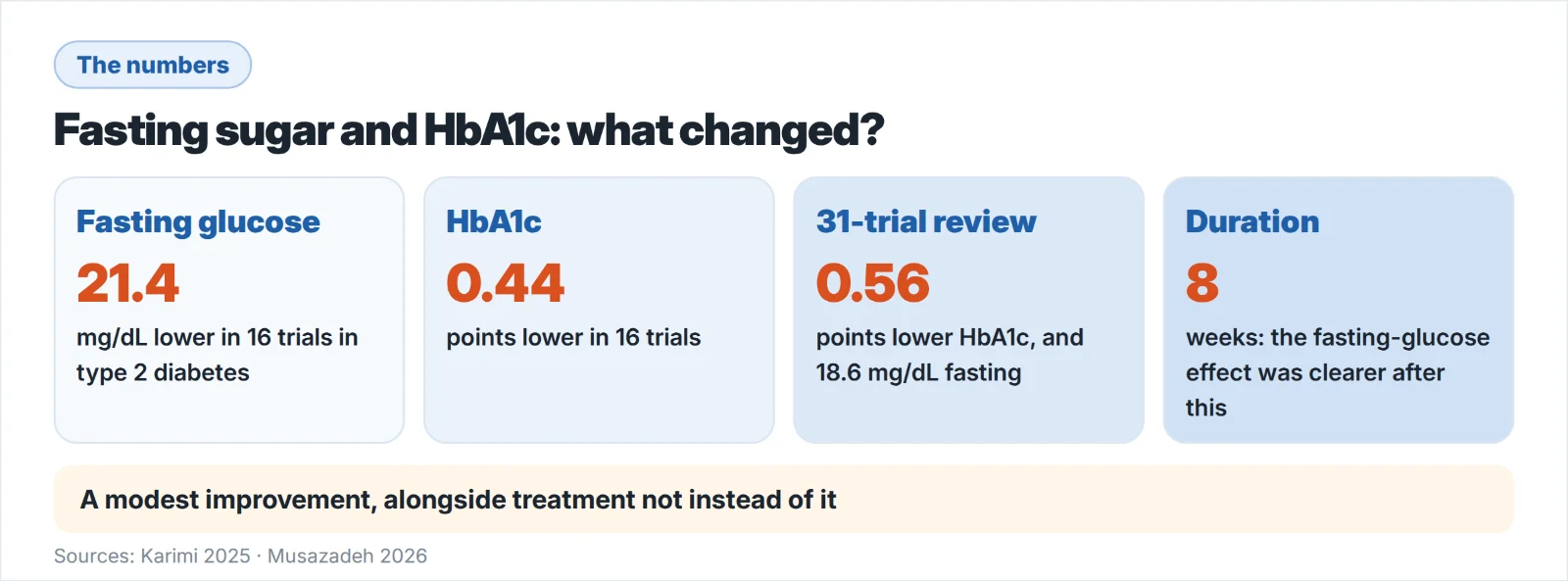
- A modest improvement: the authors of the 2026 review called it “modest improvements” and said to read results cautiously because study quality varies.
- An add-on, not a replacement: the 2025 diabetes review concluded black seed may be a beneficial adjunct therapy for glycemic and lipid control, and needs more research.
- Large variation: the 2024 review had variation between studies of 92.7% and 95.7%, and asked for research to set the ideal dose and duration.
- HbA1c fell 0.44 to 0.56 points: an average over groups, not a promise for one person.
Dose and duration
- Duration: fasting glucose fell more after more than 8 weeks (Karimi 2025), and the large reviews measured from 1 to 48 weeks.
- Dose: in the same review, HbA1c and LDL were better with doses above 1 g a day and with the oil form. Our capsule has 1000 mg, exactly 1 g, so we do not say it matches the higher doses, and we do not advise raising it without a doctor.
- Details: dose and duration are in black seed oil capsules: dose and timing.
What did not improve
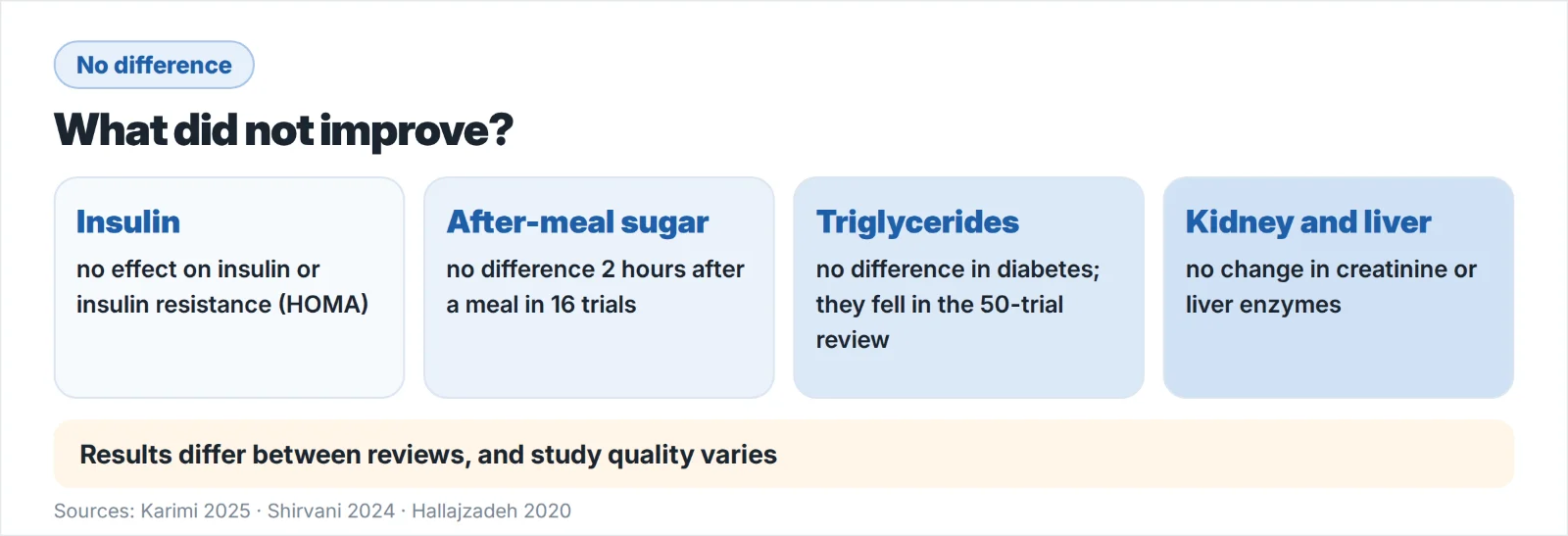
- Insulin and insulin resistance: no effect in 3 reviews (Karimi, Shirvani and Musazadeh).
- Glucose 2 hours after a meal: no difference in 16 trials in diabetes.
- Triglycerides and HDL: no difference in diabetes in the 2025 review, though the 50-trial review found triglycerides fell.
- Kidney and liver: creatinine and liver enzymes did not change in these trials.
- Weight: the diabetes review found no effect, but the 31-trial review found a 1.59 kg fall; results differ.
Who should ask a doctor first?
- People on diabetes medicines or insulin: black seed lowered sugar in the trials, so it may fall further with the medicine; keep monitoring and do not change your medicine dose yourself.
- People with diabetes generally: black seed is not a replacement for treatment, and the tests (HbA1c and fasting) decide.
- People on blood thinners such as warfarin: a lab study predicted an interaction above 1 g of oil a day.
- People on blood pressure medicines: the trials found a small fall in pressure, so keep checking it.
- People with kidney or liver disease: rare cases were reported, including a case report (we verified the title only) of acute renal failure in a diabetic patient.
- Pregnancy, breastfeeding and children, before any surgery, and anyone allergic to black seed or gelatin.
Our capsule
#1
1000 mg oilCold-pressed
Avantic Activated Black Seed – 30 Capsules
Virgin black seed oil, one capsule a day
EGP 240
30 capsules · one a day · current price from the product page
- The pack: 1000 mg black seed oil per capsule, one capsule per serving, 30 servings
- The page: cold-pressed virgin oil, made in Egypt and registered with the NFSA under 2024/11149
- The pack: bovine gelatin capsule, only 10 kcal
Heads-up: The thymoquinone percentage is not on the pack, so we will not quote one; the capsule shell is bovine gelatin
Safety details are in black seed side effects: who should avoid it.
Want to ask?
Beseha pharmacists answer on WhatsApp. Tap the “Ask a pharmacist” button and tell them your diabetes medicines before you start.
FAQ
Does black seed lower blood sugar?
A 2025 review of 16 trials in type 2 diabetes found lower fasting glucose (21.43 mg/dL) and HbA1c (0.44), a modest improvement as an add-on, not a replacement for treatment.
Should I stop my diabetes medicine?
No; do not change your medicine dose yourself, and keep monitoring because sugar may fall further with the medicine.
How long until it shows on sugar?
The effect on fasting glucose was clearer after more than 8 weeks, per the 2025 review.
Does black seed affect insulin?
Three reviews found no effect on insulin or insulin resistance, and the diabetes review found none on glucose 2 hours after a meal.
Is a 1000 mg capsule enough?
Studies used 200 to 4,600 mg a day, and HbA1c and LDL results were better with more than 1 g and with oil; we do not advise raising the dose without a doctor.
Is it suitable for everyone with diabetes?
No; anyone taking diabetes medicines or with kidney or liver disease should ask their doctor first.
Read next: Black seed: what 82 clinical studies show and black seed side effects: who should avoid it.
The bottom line
In trials black seed lowered fasting glucose by about 19 to 21 mg/dL and HbA1c by 0.4 to 0.6 points on average, a modest improvement that varies between studies. It is an add-on to your treatment, not a replacement, and if you take diabetes medicines keep monitoring and ask your doctor before you start.
Activated Black Seed at Beseha →
Sources
- Karimi et al. 2025: black seed in type 2 diabetes
- Musazadeh et al. 2026: black seed and cardiometabolic health
- Hallajzadeh et al. 2020: Nigella sativa, glycemic control and lipids
- Shirvani et al. 2024: Nigella sativa and glycemic status in adults
- Wang et al. 2022: thymoquinone and warfarin
- Arslan et al. 2013: case report, renal failure (title only)
- Jafari et al. 2025: 82 studies on black seed
This content is for information and is not a substitute for advice from a doctor or pharmacist. Prices and availability may change; the final price is on the product page.


