
- Your cart is empty
- Continue shopping
-
Beseha
- Posted on
- Categories:Skin and Beauty
- 0 comments
The 30-second answer
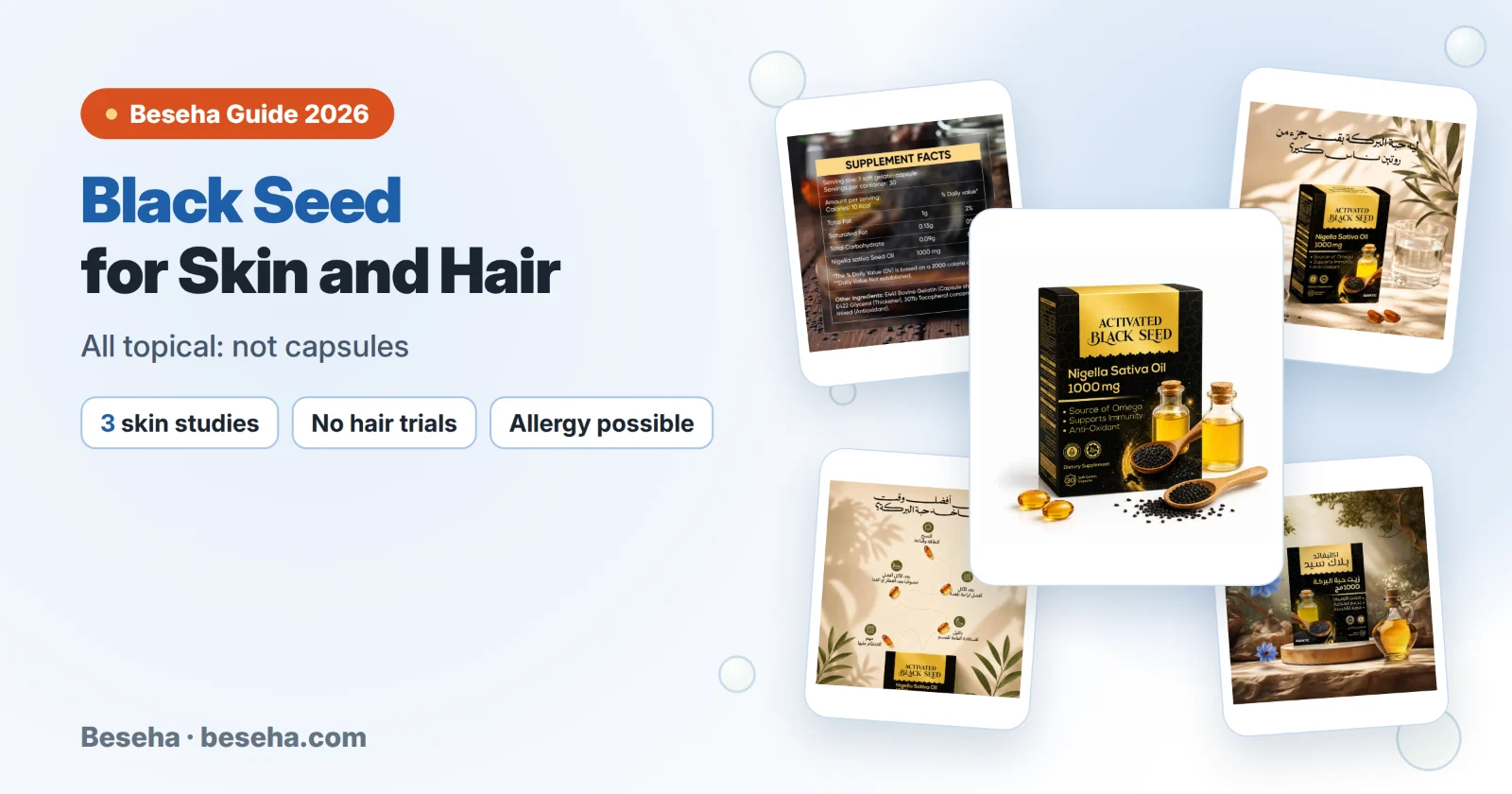
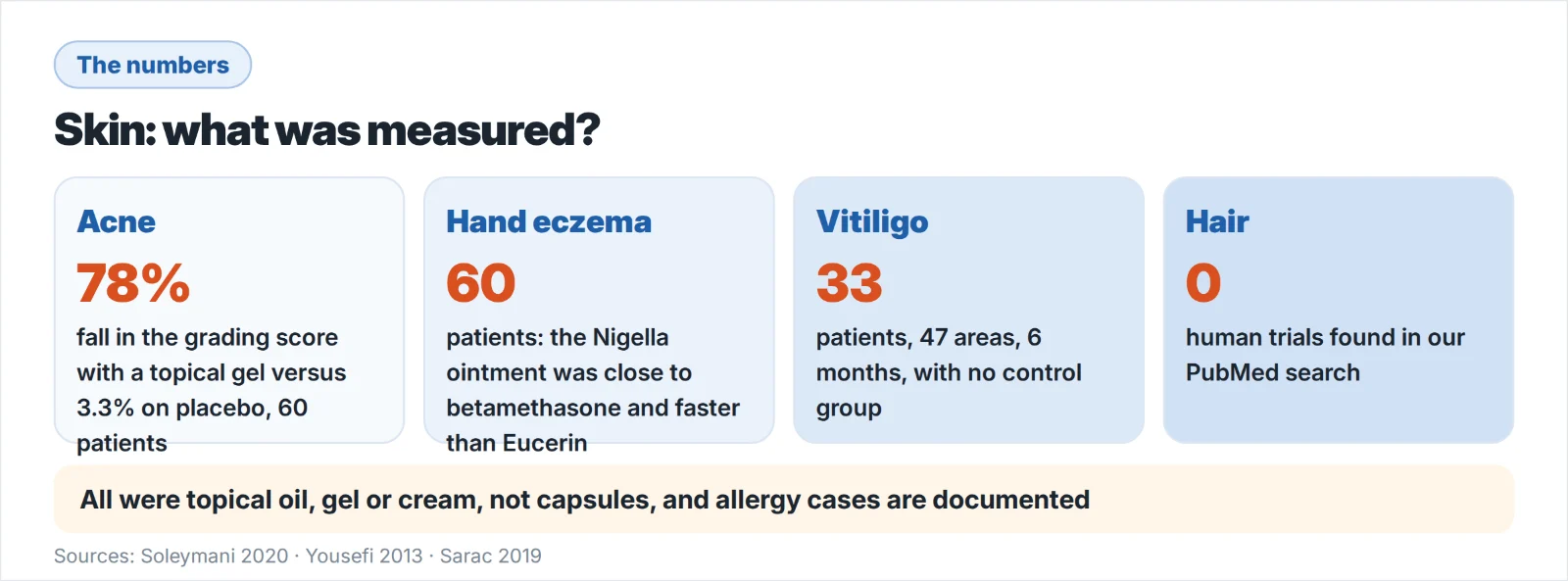
All the studies we found on black seed for skin are topical (gel, ointment and cream), not capsules: a gel for acne (60 patients, a 78% fall in the grading score versus 3.3% on placebo), an ointment for hand eczema (60 patients, close to betamethasone) and a cream for vitiligo (33 patients with no control group). On hair we found no human trial in our search. And allergic contact dermatitis cases with black seed oil are documented, including a DRESS case. So there is no basis to say the capsule improves skin or hair.
From heritage: the seed and the oil in the nose
In Sahih al-Bukhari (5687), in the story of treating Ghalib ibn Abjar: Ibn Abi Atiq described five or seven black seeds crushed with drops of oil in the nose, and said: «This black seed is a cure for every disease except al-Sam». So the reported use was topical in a specific way, and unrelated to skin or hair. That explains its place in our culture, not a promise of a result, so what did modern research find?
Acne, eczema and vitiligo: the trials
| Study | Type and sample | Form and duration | Result |
|---|---|---|---|
| Soleymani 2020 | Double-blind randomised trial: 60 patients with acne (30 and 30) | Black seed hydrogel standardised to thymoquinone, twice daily for 60 days | The IGA grading score fell 78% versus 3.3% on placebo; comedones, papules and pustules fell; the acne disability index fell 63.49% versus 4.5%; no adverse events were recorded |
| Yousefi 2013 | Double-blind randomised trial: 60 patients with hand eczema (20 per arm), with 19, 15 and 18 attending | Black seed ointment twice daily versus betamethasone and a moisturiser (Eucerin) for 4 weeks | The black seed ointment and betamethasone improved faster than the moisturiser (P = 0.003 and P = 0.012) and the quality-of-life score fell; there was no significant difference between black seed and betamethasone |
| Sarac 2019 | Study with no control group: 33 patients with vitiligo, 47 areas | Black seed oil cream twice daily for 6 months on the hands, face and genital area | Significant repigmentation in all three areas (p = 0.005, 0.001 and 0.004); the authors: possible as an adjuvant treatment |
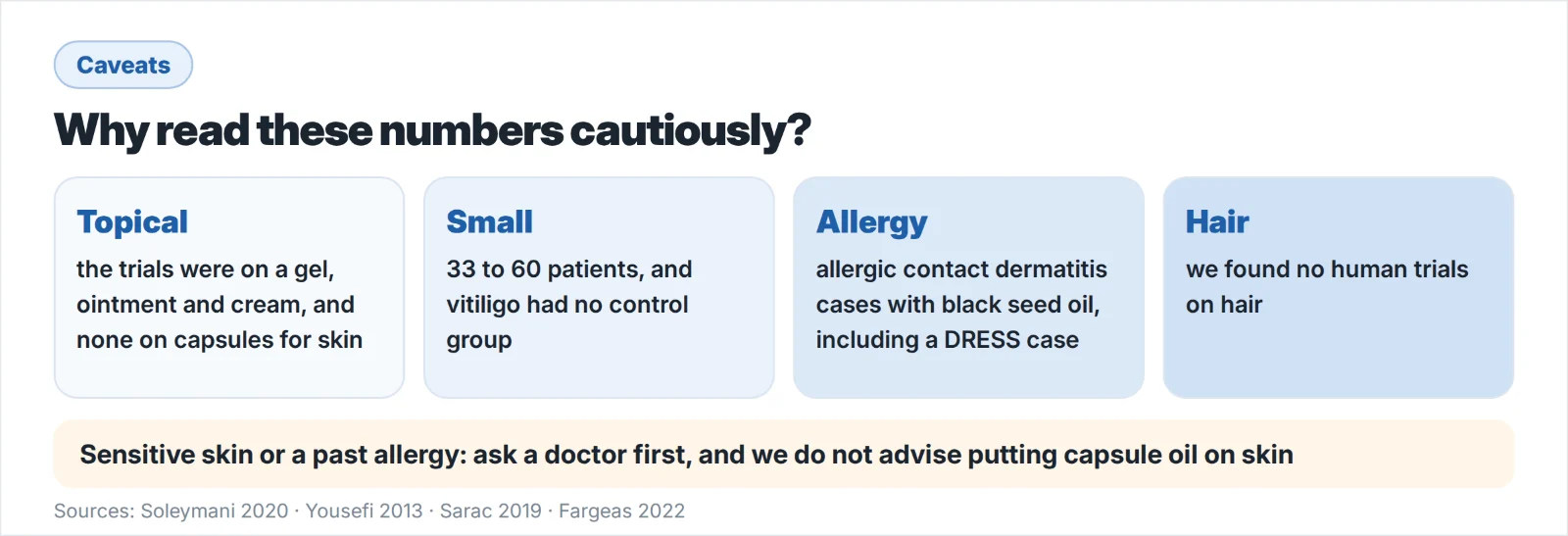
- All were topical: a gel, ointment and cream, not oral capsules. Our capsule is oral, so no study links it to the skin.
- Small: 33 to 60 patients, and vitiligo had no control group, so its result is weaker.
- Eczema and vitiligo: skin diseases whose treatment a dermatologist decides; this article is no substitute for treatment.
- Hair: our PubMed search for black seed and hair loss returned no human trial, so we do not say it helps hair.
Allergy: you need to know
Documented dermatology reports describe allergic contact dermatitis from black seed oil: a case study (Kurihara 2020) found thymoquinone a causative allergen with cross-reactivity to TBHQ, five new cases (Seiller 2021) treat TBHQ as a marker of black seed oil allergy, and a case of DRESS syndrome (a rash with eosinophilia and systemic symptoms) after topical use (Fargeas 2022). And the LactMed database says the oil can cause allergic contact dermatitis. These are published cases, not a rate, but reason enough for care: if your skin is sensitive or you have a past allergy, ask a dermatologist, and if a rash, swelling or wheeze appears, stop.
And the capsule?
- Our capsule is 1000 mg of oil taken by mouth, and the serving is one capsule. No study says it improves skin or hair.
- We do not advise opening the capsule or putting its oil on the skin: there is no study on it, and allergy is documented.
- The thymoquinone percentage is not on our label (the acne gel in the study was standardised to thymoquinone). If you take it for other reasons, details are in black seed oil capsules: dose and timing.
Who should ask a doctor first?
- Sensitive skin, eczema or a past allergy (especially to oils or foods): a dermatologist before any black seed product.
- Severe acne, vitiligo, eczema or hair loss: the cause needs a diagnosis, and the doctor decides treatment.
- Pregnant and breastfeeding women: there is not enough data, and no proof it increases milk.
- Children: 15 trials found no significant side effects by mouth, but the dose is not established and our pack has no child dose; and a child’s sensitive skin needs a doctor.
- People on blood thinners such as warfarin: a lab study predicted an interaction above 1 g of oil a day.
- People on diabetes or blood pressure medicines, and those with kidney or liver disease: rare cases were reported after black seed oil.
- A rash, swelling, severe itching or wheeze appeared: stop and call the doctor immediately.
Our capsule
#1
1000 mg oilCold-pressed
Avantic Activated Black Seed – 30 Capsules
Virgin black seed oil, one capsule a day
EGP 240
30 capsules · one a day · current price from the product page
- The pack: 1000 mg black seed oil per capsule, one capsule per serving, 30 servings
- The page: cold-pressed virgin oil, made in Egypt and registered with the NFSA under 2024/11149
- The pack: bovine gelatin capsule, only 10 kcal
Heads-up: The thymoquinone percentage is not on the pack, so we will not quote one; the capsule shell is bovine gelatin
Want to ask?
Beseha pharmacists answer on WhatsApp. Tap the “Ask a pharmacist” button and tell them your medicines before you start.
FAQ
Is black seed oil good for the skin?
Small trials on a gel for acne (60 patients), an ointment for eczema (60 patients) and a cream for vitiligo (33 patients with no comparison), all topical; and no study on capsules for the skin.
Is it good for hair?
We found no human trial on black seed and hair loss in our PubMed search, so we do not say it helps.
Can I put the capsule oil on my skin?
We do not advise it: no study on it, and allergic contact dermatitis cases with black seed oil are documented; ask a dermatologist.
Can it cause allergy?
Yes: allergic contact dermatitis cases are documented, including a DRESS case after topical use; and if a rash or swelling appears, stop.
Does it help acne?
A thymoquinone-standardised gel lowered the acne score 78% versus 3.3% on placebo in 60 patients, but it is a gel not capsules, and the trial is small.
Does it replace eczema or vitiligo treatment?
No; the trials are small (and vitiligo had no comparison), and a dermatologist decides treatment.
Read next: Black seed: what 82 clinical studies show, black seed for women and black seed side effects: who should avoid it.
The bottom line
The skin trials are topical and small (a gel for acne, an ointment for eczema and a cream for vitiligo), we found no hair trials, and allergy cases are documented. So there is no basis to say the black seed capsule improves skin or hair, and we do not advise putting its oil on the skin. Sensitive skin or a skin disease: a dermatologist first.
Activated Black Seed at Beseha →
Sources
- Soleymani et al. 2020: Nigella sativa hydrogel for acne vulgaris
- Yousefi et al. 2013: topical Nigella versus betamethasone in hand eczema
- Sarac et al. 2019: topical Nigella sativa for vitiligo
- Kurihara et al. 2020: thymoquinone as an allergen in Nigella sativa oil contact dermatitis
- Seiller et al. 2021: TBHQ as a marker of Nigella sativa oil allergy, five cases
- Fargeas et al. 2022: DRESS syndrome after topical Nigella sativa oil
- LactMed 2025: black seed, breastfeeding and skin
- Wang et al. 2022: thymoquinone and warfarin
- Islamweb: fatwa on using black seed as a remedy (Arabic)
This content is for information and is not a substitute for advice from a doctor or pharmacist. Prices and availability may change; the final price is on the product page.


