
- Your cart is empty
- Continue shopping
-
Beseha
- Posted on
- Categories:Healthy Food
- 0 comments
The 30-second answer
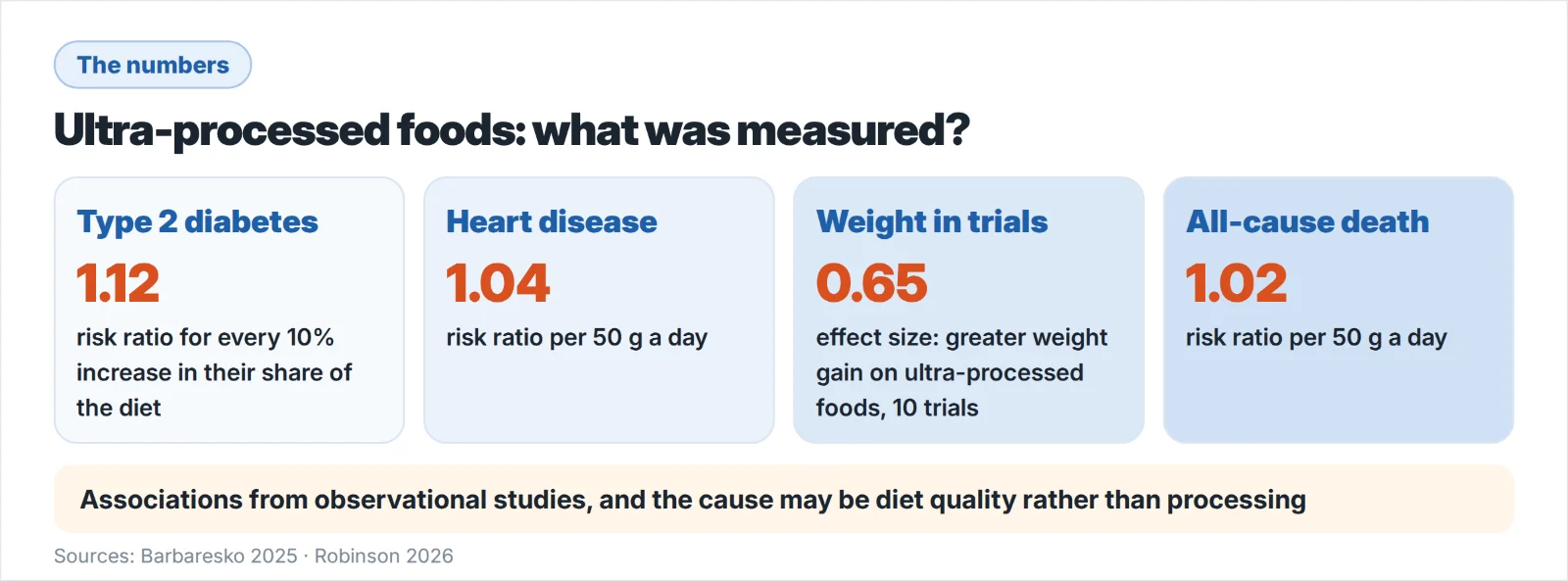
A 2025 umbrella review of 16 publications found an association between ultra-processed foods (by the NOVA classification) and a slight increase in the risk of death, heart disease, type 2 diabetes and colorectal cancer, with moderate certainty, but said it is unclear whether processing itself is the cause or just a marker of poor diet quality. A 2026 review of 10 randomised trials found greater weight gain on ultra-processed foods (effect size 0.65), with low certainty, which the energy density of the foods may explain. So: cut down on them, without exaggeration.
The umbrella review: the numbers
| Outcome | Risk ratio (95% CI) | Certainty of evidence |
|---|---|---|
| All-cause death (per 50 g a day) | 1.02 (1.01 to 1.03) | Moderate |
| Heart disease: incidence (per 50 g a day) | 1.04 (1.02 to 1.06) | Moderate |
| Heart disease: death (per 50 g a day) | 1.05 (1.01 to 1.08) | Moderate |
| Type 2 diabetes: incidence (per 10%) | 1.12 (1.10 to 1.13) | Moderate |
| Colorectal cancer (per 10%) | 1.04 (1.01 to 1.07) | Moderate |
| Inflammatory bowel disease, obesity, fatty liver, mental health | Similar estimates | Limited |
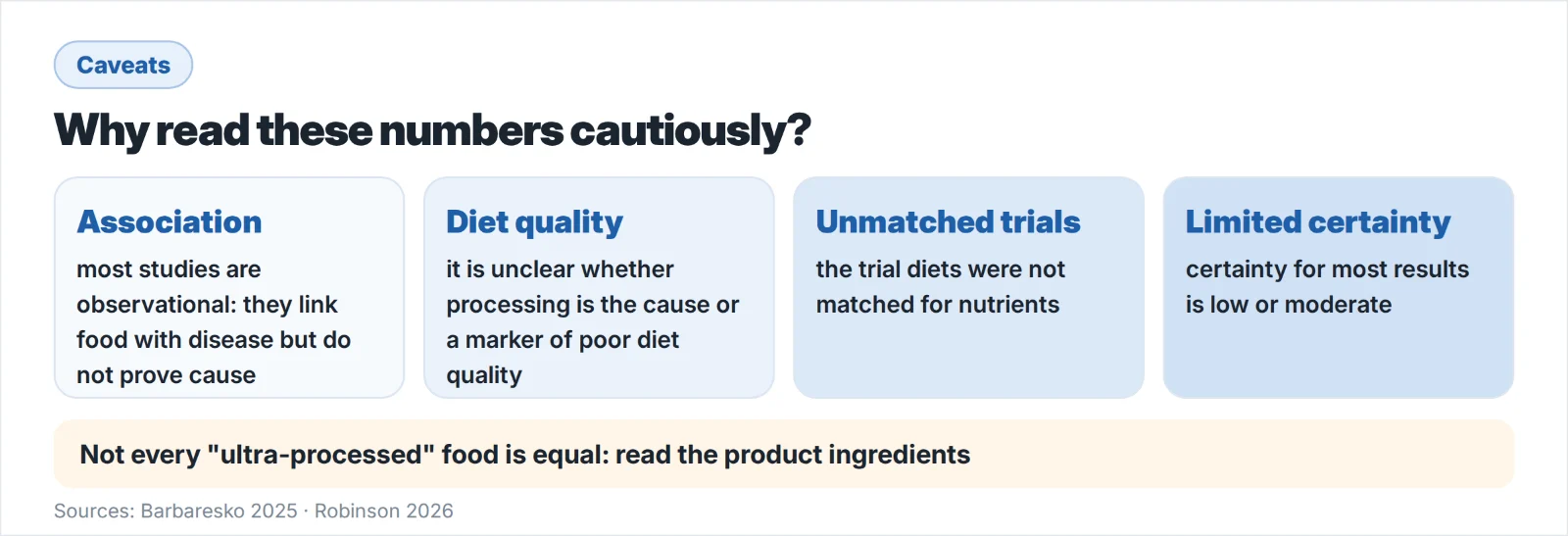
- The numbers are small: a ratio of 1.02 means a 2% relative increase per 50 g, not a big risk for an individual.
- Not proof of cause: the review said plainly that it is unclear whether processing raises risk or whether ultra-processed foods are only a measure of poor diet quality.
Do they add weight? Randomised trials
The 2026 Robinson review (Crit Rev Food Sci Nutr) pooled 10 randomised trials comparing ultra-processed with less processed foods. The ultra-processed arms tended to higher energy intake (effect sizes 0.18 to 0.44) though significance varied by model, and weight gain was significantly greater (0.65) and eating rate faster (0.96). There was no difference in appetite or in energy intake later in the day. Most important: the trial diets were not matched for nutrients; when the ultra-processed foods were higher in energy density an effect appeared (0.71), and when similar it vanished (0.02). The authors described the certainty as low.
What to do in practice
- Read the ingredient list: foods with a short list of familiar ingredients are easier to judge than ones with a long list of additives. This is practical advice, not a result from the studies.
- Focus on overall diet quality: the studies say the problem may be poor diet quality, so increase vegetables, fruit, protein and fibre (details in gut health in numbers).
- Start with simple alternatives: at Beseha there is a healthy food and drinks section and a healthy snacks section. Read each product’s ingredients on its page before choosing, because we do not call any product “not ultra-processed” without you seeing its ingredients.
- You do not have to ban everything: reduce the amount and frequency, and ask your doctor or a dietitian if you have diabetes, high blood pressure or a chronic illness.
Ask a doctor or dietitian first if
- You have diabetes, high blood pressure, high lipids, kidney or any chronic disease and plan to change your diet.
- You are pregnant, breastfeeding or feeding a child, or have an eating disorder.
- You have an allergy or intolerance to any ingredient.
Want to ask?
Beseha pharmacists answer on WhatsApp. Tap the “Ask a pharmacist” button and tell them your condition before you change your diet.
FAQ
What are ultra-processed foods?
Foods placed in the most processed group of the NOVA system, which the umbrella review used; the review itself discussed that the classification does not settle whether processing is the cause.
Do they cause diabetes and heart disease?
The 2025 review found a slight association with type 2 diabetes risk (1.12 per 10%) and heart disease (1.04 per 50 g), with moderate certainty; that is an association, not proof of cause.
Do they add weight?
The 2026 review of 10 trials found greater weight gain (effect size 0.65) with low certainty, which the foods’ energy density may explain.
Should I ban them completely?
The studies do not say that; reduce the amount and frequency and focus on overall diet quality, and ask your doctor if you have a disease.
How do I judge a product?
Read the ingredient list on the product page; a short list of familiar ingredients is easier to judge. This is practical advice, not a study result.
Read next: daily immunity habits and gut health in numbers.
The bottom line
Ultra-processed foods are linked to a slight increase in the risk of many diseases and to weight gain in trials, but certainty is moderate to low and it is unclear processing is the cause. The practical answer: cut down on them, read the ingredients and focus on overall diet quality, without panic.
Browse healthy foods at Beseha →
Sources
- Barbaresko et al. 2025: ultra-processed food consumption and human health, umbrella review
- Robinson et al. 2026: ultra-processed food, energy intake and weight gain, meta-analysis of randomised trials
This content is for information and is not a substitute for advice from a doctor or pharmacist. Prices and availability may change; the final price is on the product page.


