
- Your cart is empty
- Continue shopping
-
Beseha
- Posted on
- Categories:Kids' Health
- 0 comments
The 30-second answer
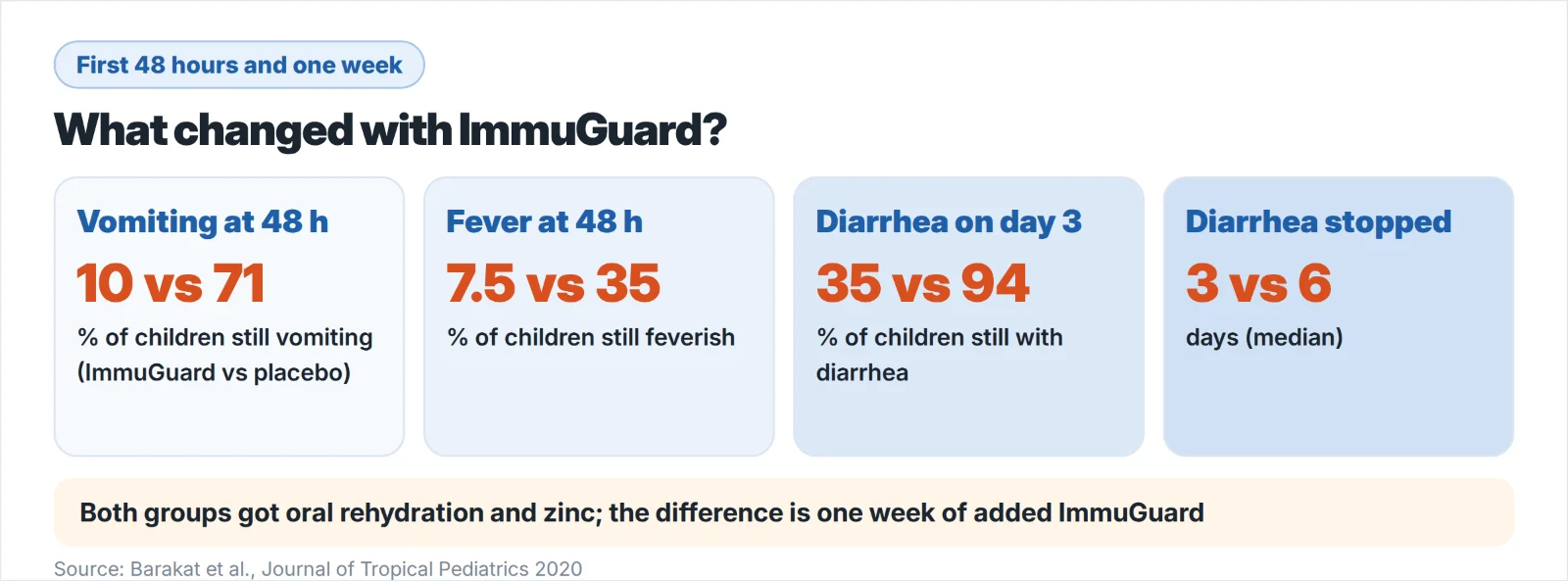
In the Alexandria University trial on ImmuGuard (160 children aged 6 months to 2 years with acute diarrhea), half took one sachet a day for a week on top of oral rehydration and zinc. At 48 hours 10% were still vomiting versus 71% on placebo, and diarrhea stopped after 3 days versus 6 (median). It is an add-on to treatment, not a substitute; with blood in the stool or a child who will not drink, see a doctor right away.
Egyptian university studies on ImmuGuard itself
ImmuGuard is one of few bovine colostrum products with research published in scientific journals from Egyptian universities, under the same brand name and 3 g sachet that Beseha sells. Not every result is equally strong, and here is how they compare:
| University | Journal and year | Sample and design | Result | Strength |
|---|---|---|---|---|
| Alexandria University | Journal of Tropical Pediatrics 2020 | 160 children with acute diarrhea, randomised double-blind placebo-controlled | Less vomiting, fever and diarrhea, and diarrhea stopped sooner | Strong |
| Assiut, South Valley and Al-Azhar universities | Medicine 2016 | 160 children with recurrent infections, open, no comparison group | Infections 8.6 to 5.5 in two months, hospital admissions 2.2 to 0.9 | Preliminary |
| Ain Shams University | Pediatric Research 2021 | 80 preterm infants (under 34 weeks) in the NICU, randomised double-blind | Higher regulatory T cells; the difference in necrotizing enterocolitis and late-onset sepsis was not significant. For preterm infants in the NICU under medical supervision only | Preliminary (NICU only) |
| Ain Shams University | World J Clin Pediatr 2026 | 60 children with kidney and urinary tract anomalies, randomised double-blind | Overall urinary infections not statistically significant; cystitis and respiratory and gut infections lower | Preliminary (small sample) |
The first is the subject of this article because it is the strongest: randomised, double-blind, placebo-controlled and registered in advance.
The Alexandria University trial: how was it run?
- Who: 160 children aged 6 months to 2 years (mean 12 months) with acute diarrhea (three or more loose stools in under 48 hours, with no blood or mucus).
- Where and when: the emergency room of the university children’s hospitals (Alexandria University), November 2016 to May 2017. The trial is registered in the Pan African Clinical Trials Registry (PACTR201708002507912).
- Groups: 80 children took ImmuGuard and 80 took an identical-looking placebo, allocated by computer with sealed opaque envelopes, and neither the caregivers nor the outcome assessors knew who got what.
- Standard care for both: oral rehydration solution, zinc and continued feeding following the WHO protocol.
- ImmuGuard: a 3 g sachet daily for one week; per the paper it contains 350 mg IgG, 65 mg lactoferrin, 35 mg IgA and 25 mg IgM, dissolved in 50 mL of boiled, cooled water and taken 30 minutes before food. (The label on Beseha’s box states 1000 mg of whole bovine colostrum per sachet and does not list IgG, so these figures come from the paper, not the box.)
- Excluded: diarrhea over 48 hours, malnutrition, and any child who had already had an antibiotic or an antidiarrheal.
The results in numbers
| Measure | ImmuGuard (80) | Placebo (80) |
|---|---|---|
| Vomiting at 48 hours | 10% (8 children) | 71% (57 children) |
| Fever at 48 hours | 7.5% (6) | 35% (28) |
| Severity score (Vesikari) at 48 hours, median | 3 | 6 |
| Diarrhea still present on day 3 | 35% (28) | 94% (75) |
| Diarrhea still present at one week | 0 | 12.5% (10) |
| Day diarrhea stopped, median | 3 days | 6 days |
| Day vomiting stopped, median | 1 | 3 |
All these differences are statistically significant (p under 0.001 for most, and 0.001 for diarrhea at one week). The result held when children were analysed by cause: in rotavirus (22 on ImmuGuard and 34 on placebo) and E. coli (13 and 18), diarrhea stopped after a median of 3 days versus 6 in both. These numbers are small, so take them as a direction, not a final calculation.
The limits of the trial (you should know them)
- One centre: Alexandria University hospitals with 160 children, so larger trials at other centres are needed.
- A small baseline difference: the groups differed in how often they vomited before treatment (قيمة p: 0.026), so the vomiting comparison in particular calls for caution.
- Short: one week of use, so it says nothing about benefit afterwards.
- Ordinary, not hyperimmune colostrum: it is not made from cows immunised against a specific virus, and other research on hyperimmune types does not give the same picture.
- Standard care continued: the difference is the effect of adding ImmuGuard on top of oral rehydration and zinc, not instead of them.
What did research from outside Egypt say?
- A 2019 meta-analysis (Scientific Reports): 5 randomised trials in childhood infectious diarrhea; bovine colostrum cut stool frequency by 1.42 a day (confidence interval -2.70 to -0.14) and reduced the occurrence of diarrhea by 71% (OR=0.29). That points the same way as the Alexandria result, but the trials themselves are small and differ in product and dose.
- Hyperimmune anti-rotavirus colostrum (1998): 80 children, 10 g a day for 4 days, less stool output and less rehydration solution, and the virus cleared sooner (day 1.5 versus 2.9). This is a different type of colostrum (hyperimmune), so we cite it as support, not as proof for ImmuGuard.
- A Guatemalan trial (2017): a hyperimmune colostrum and egg product in 301 children, no difference overall, with benefit only when a targeted pathogen was in the stool. So the result is not the same in every setting.
Safety: what was recorded?
- In the Assiut, South Valley and Al-Azhar study (160 children took ImmuGuard for a month): 12 children (7.5%) had a time-related effect: skin rash (9), itching (1) and diarrhea (2), all mild and temporary, and only 6 stopped treatment.
- In the 2026 Ain Shams study (30 children on ImmuGuard): no adverse effects or allergic reactions were recorded.
- The studies excluded children with a known allergy to colostrum, and the Assiut study excluded those with lactose intolerance.
- A 2021 review of colostrum in children’s health says allergy and intolerance appear unlikely when it is used as a supplement within normal nutrition, and that it is not a sole food for infants.
Ask your child’s doctor or a pharmacist first if
- The child is under 6 months: the trial covered 6 months to 2 years.
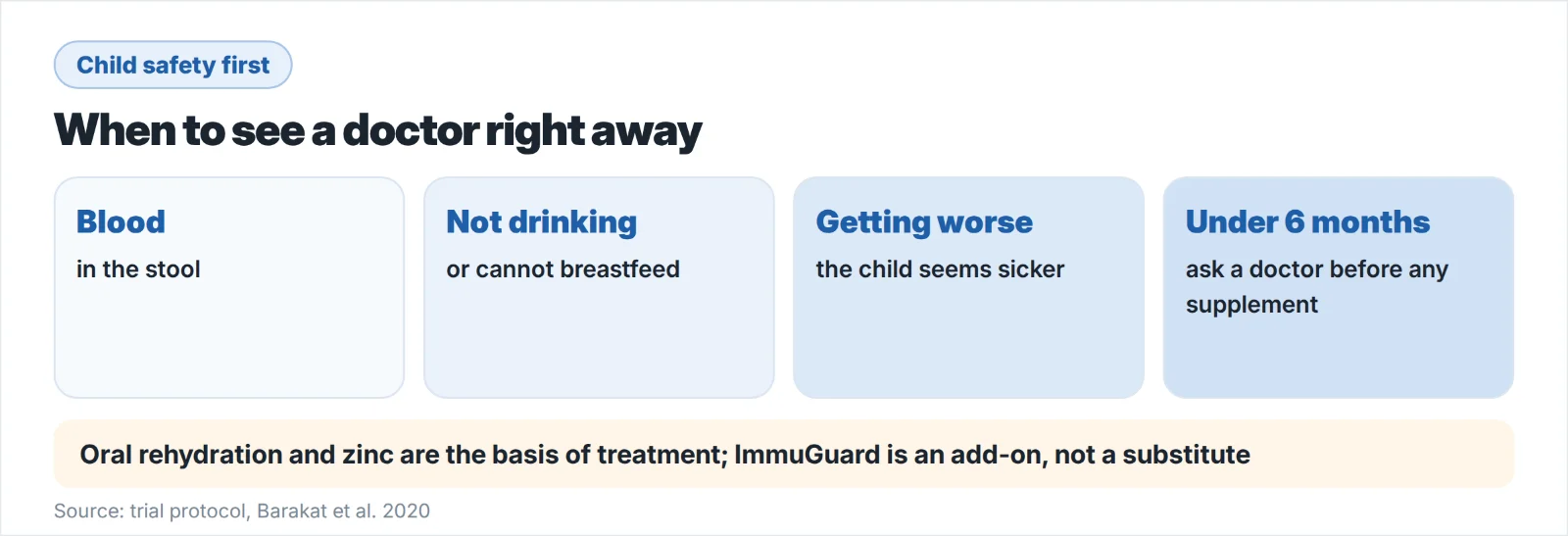
- There is blood in the stool, or the child will not drink, cannot breastfeed or is getting worse: see a doctor right away and do not wait for any supplement.
- The child is allergic to cow’s milk or lactose intolerant: the product contains skimmed milk, and the label says it may contain nuts, fish oil and soy protein.
- The child has a chronic illness or takes regular medicines: talk to the doctor before adding any supplement.
- Diarrhea lasts more than two days or keeps coming back: it needs a diagnosis, and a supplement will not replace it.
- Keep up the oral rehydration solution, zinc and feeding as the doctor said: ImmuGuard is an add-on.
ImmuGuard at Beseha
The dose studied in diarrhea: one 3 g sachet daily for a week in children aged 6 months to 2 years. Follow the pack instructions and your child’s doctor, and the current price is on the product page:
#1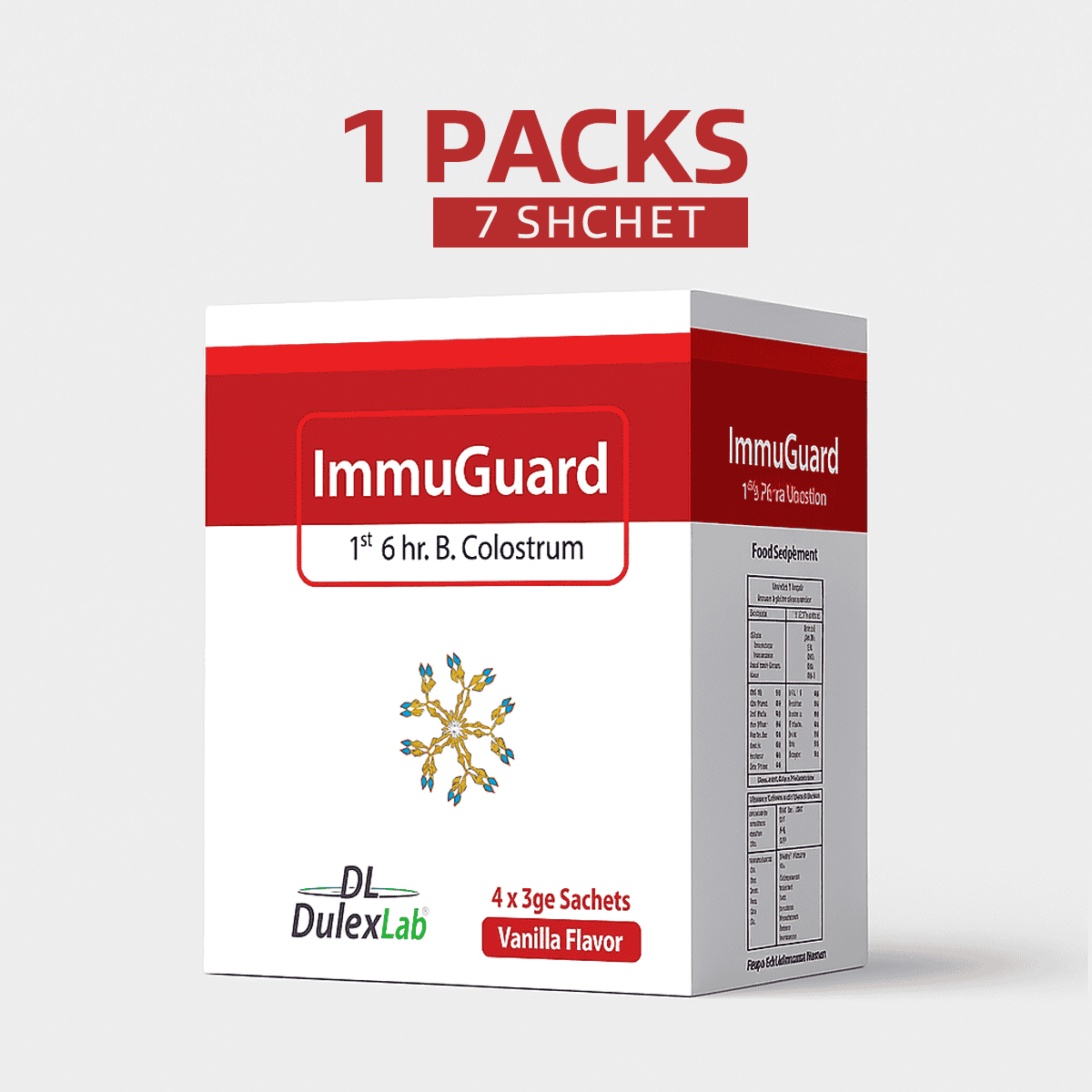
First 6 hours3 g sachetTo try
ImmuGuard – Bovine Colostrum – 7 Sachets
Bovine colostrum sachets, studied for a week alongside oral rehydration
EGP 115
7 sachets · current price from the product page
- The page: pure bovine colostrum from the first 6 hours after birth, registered with the Egyptian National Food Safety Authority under 2022/3652
- The page: dissolves in a little water, milk or juice
- The studies: 4 studies on it at Egyptian universities (Alexandria, Assiut, South Valley, Al-Azhar and Ain Shams)
Heads-up: It contains skimmed milk (cow’s milk), so it is not for a child allergic to cow’s milk; talk to your child’s doctor before starting
#2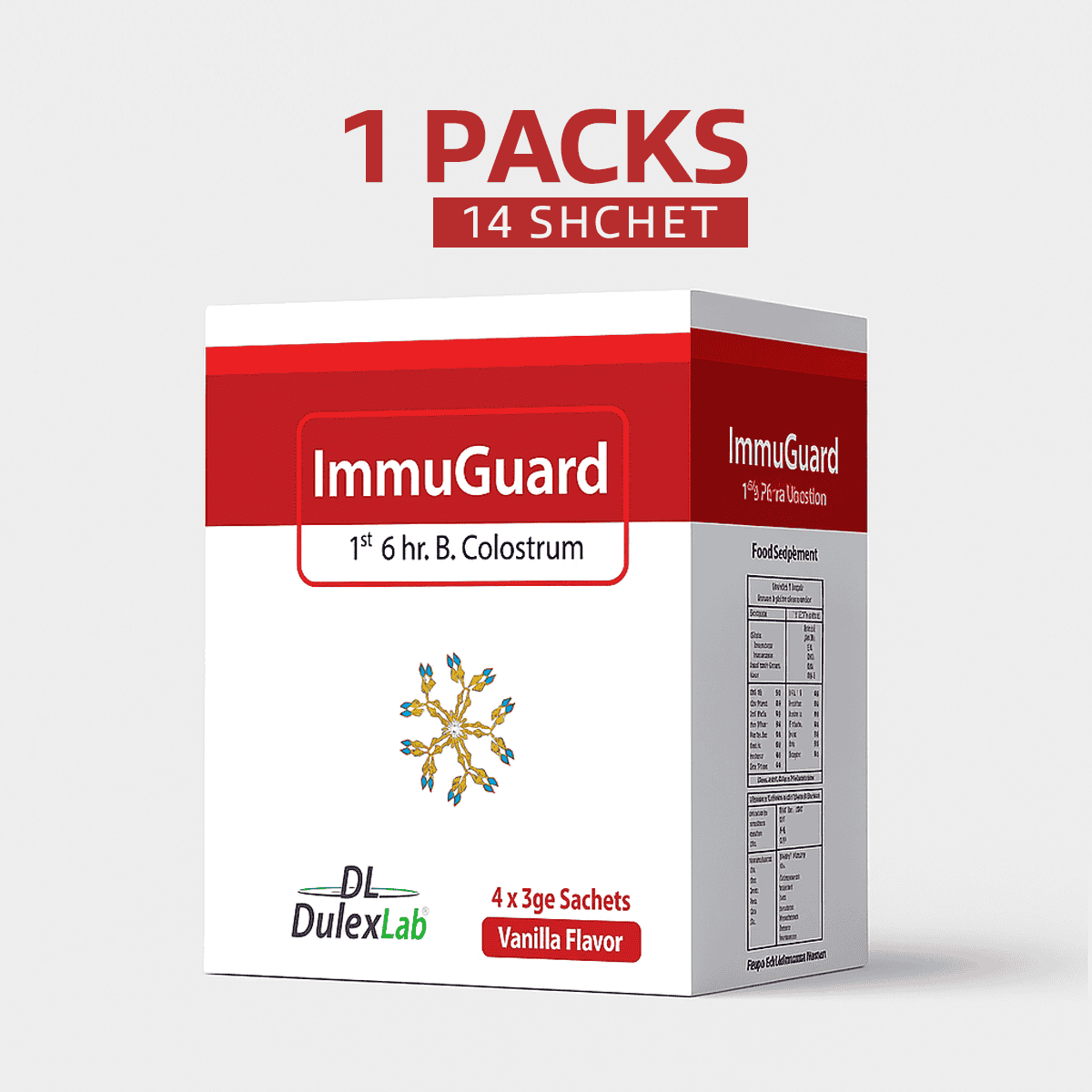
First 6 hours3 g sachetBetter value
ImmuGuard – Bovine Colostrum – 14 Sachets
Double the quantity at a lower price per sachet
EGP 195
14 sachets · current price from the product page
- The page: the same formula in a 14-sachet pack for longer use
- The studies: tested at one sachet a day for a week in diarrhea and for a month in recurrent infections
- The page: registered with the Egyptian National Food Safety Authority under 2022/3652
Heads-up: The same warning: it contains cow’s milk, so talk to the doctor if there is an allergy or a chronic illness
Not sure?
Beseha pharmacists answer on WhatsApp. Tap the “Ask a pharmacist” button and tell them the child’s age, symptoms and any medicines.
FAQ
Does ImmuGuard stop diarrhea?
In the Alexandria University trial it shortened diarrhea (median 3 days versus 6) on top of oral rehydration and zinc, but it is an add-on to treatment and does not replace oral rehydration solution.
From what age?
The trial covered children from 6 months to 2 years; for under 6 months ask a doctor first.
How many sachets a day?
In the Alexandria trial: one 3 g sachet a day for a week. Follow the pack instructions and your child’s doctor.
Does it work for viral and bacterial diarrhea?
A similar direction appeared in rotavirus (22 versus 34) and E. coli (13 versus 18) cases, but the numbers are small.
Does it have side effects?
The Assiut, South Valley and Al-Azhar study recorded rash, itching and mild diarrhea in 7.5% of children, and the 2026 Ain Shams study recorded no adverse effects.
Does it replace oral rehydration?
No; children in the trial took oral rehydration and zinc in both groups, and the difference is the effect of adding ImmuGuard.
Are all the studies Egyptian?
The studies on ImmuGuard itself come from Alexandria, Assiut, South Valley, Al-Azhar and Ain Shams universities, supported by a 2019 international meta-analysis of 5 trials in childhood diarrhea.
Read next: ImmuGuard: doctors’ opinion in Egypt, is bovine colostrum safe for children and research reference on bovine colostrum.
The bottom line
The strongest evidence on ImmuGuard today is the Alexandria University trial in children’s diarrhea: randomised and double-blind, with less diarrhea, vomiting and fever when it was added to oral rehydration and zinc. The rest of the evidence is preliminary, the numbers are small, and the product is an add-on to treatment, not a substitute. With blood, dehydration or a child under 6 months, the doctor comes first.
Sources
- Barakat et al. 2020 (Alexandria University): Bovine colostrum in the treatment of acute diarrhea in children
- Saad et al. 2016 (Assiut, South Valley, Al-Azhar): Bovine colostrum in recurrent infections in children
- Said et al. 2026 (Ain Shams): Bovine colostrum for recurrent urinary tract infections in children
- Li et al. 2019: meta-analysis in childhood infectious diarrhea
- Sarker et al. 1998: hyperimmune anti-rotavirus bovine colostrum
- Gaensbauer et al. 2017: colostrum and egg product in Guatemala
- Sangild et al. 2021: Bovine colostrum in pediatric nutrition and health
This content is for information and is not a substitute for advice from a doctor or pharmacist. Prices and availability may change; the final price is on the product page.


