
- Your cart is empty
- Continue shopping
-
Beseha
- Posted on
- Categories:Supplements and Vitamins
- 0 comments
The 30-second answer
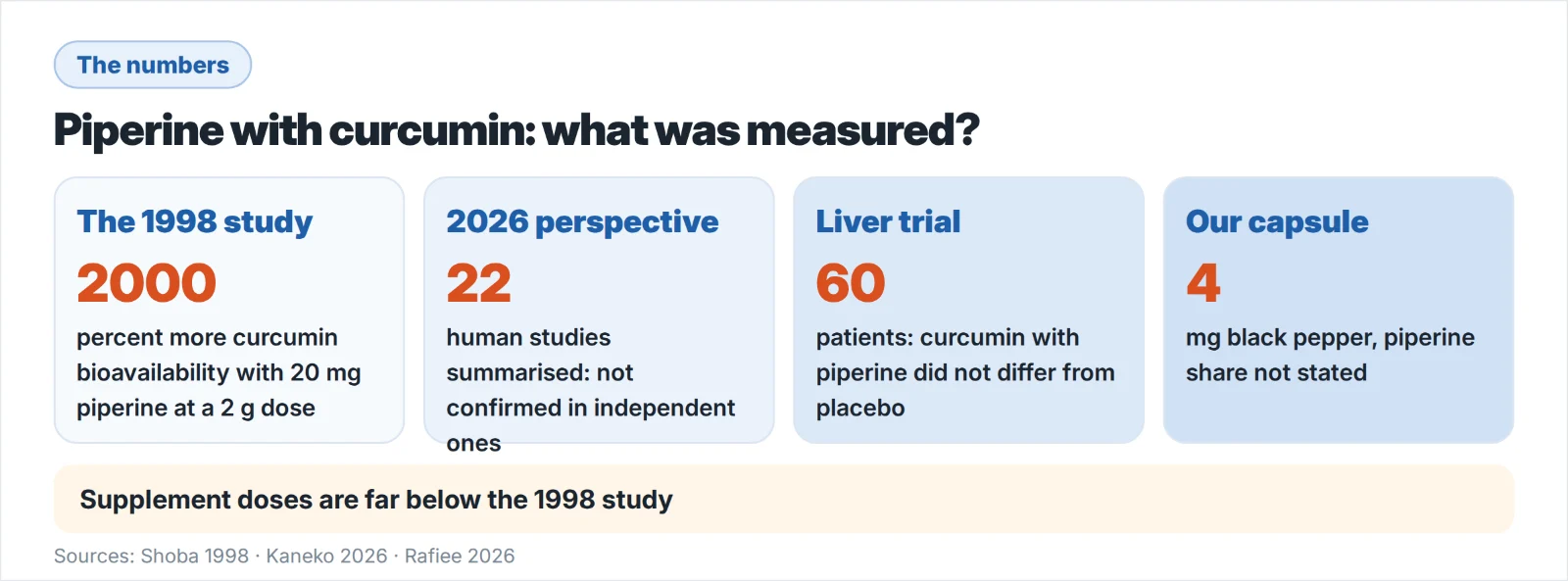
The “2000 percent” figure comes from a 1998 study in volunteers: 2 g of curcumin alone was almost undetectable in blood, and with 20 mg of piperine bioavailability rose 2000 percent. But a 2026 perspective summarised 22 human studies and found the improvement comes from manufacturer-affiliated studies, that it was not confirmed without their funding at supplement doses, and that piperine blocks liver enzymes and P-gp and can change exposure to other medicines. In a 60-patient trial (curcumin 500 mg + piperine 5 mg, 12 weeks) there was no difference from placebo in fatty liver. Our capsule has 4 mg of black pepper with an undeclared piperine share and about 80 mg of curcuminoids, far from the 1998 doses. And there is no study on it.
Black pepper in our capsule
#1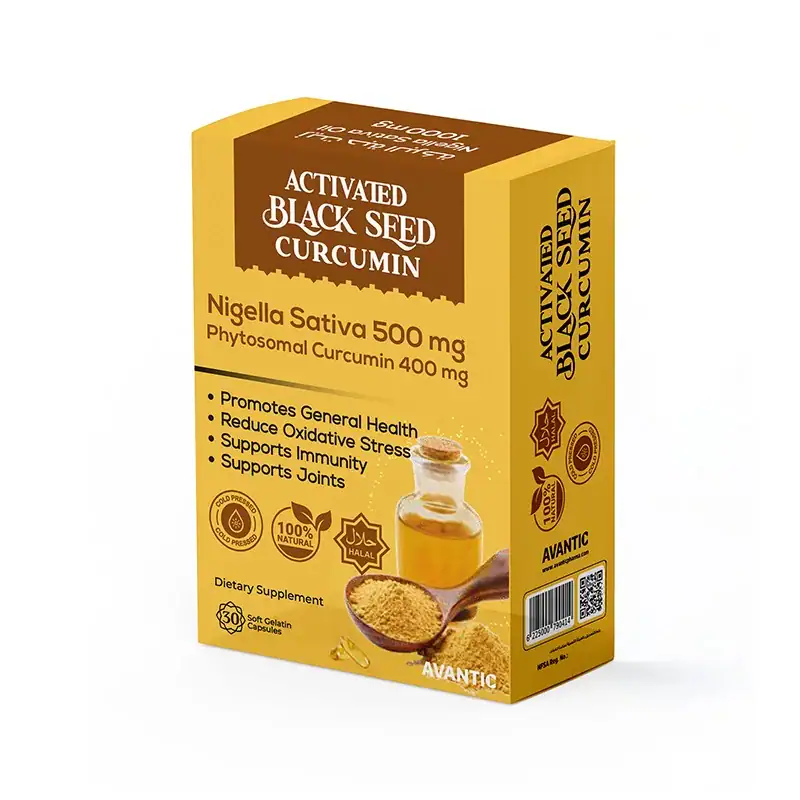
Black pepper 4 mgMeriva 400 mg
Activated Black Seed Curcumin – 30 softgels
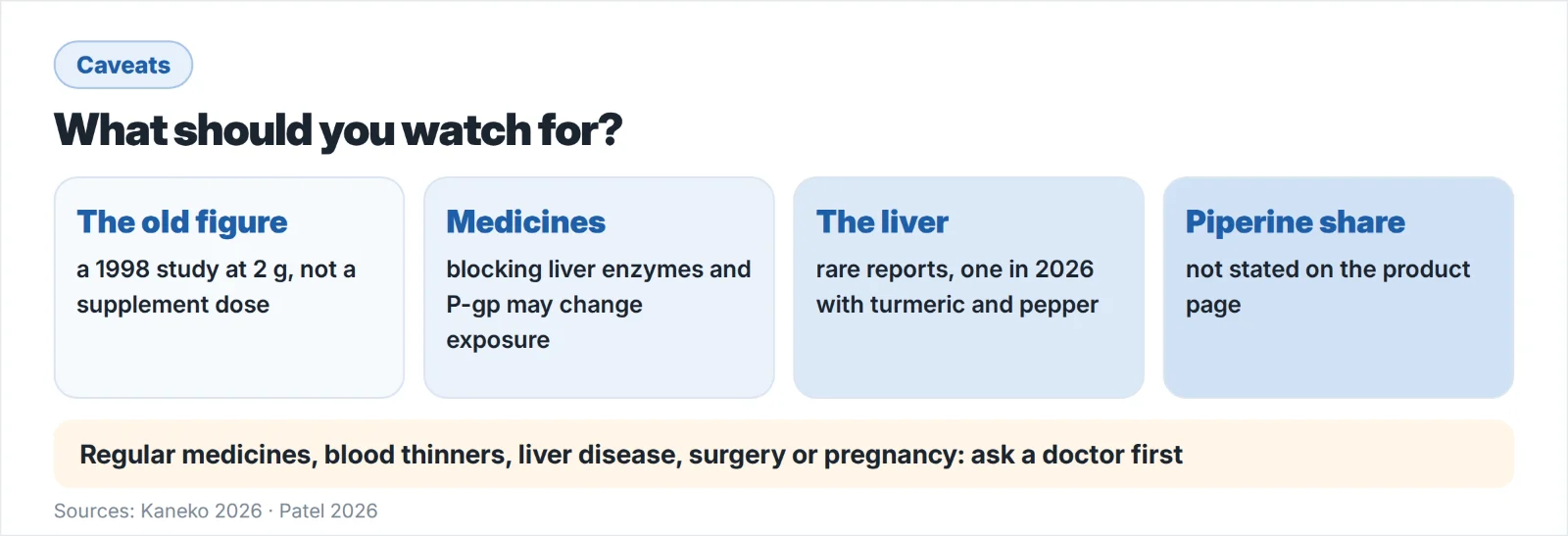
Black pepper with no declared piperine share
EGP 240
30 softgels · current price from the product page
- The page: black pepper extract 4 mg “within the curcumin system”, and it says it does not state the piperine share and does not count it as 4 mg of piperine
- The page: curcumin phytosome 400 mg (about 72 to 88 mg curcuminoids by the company spec) and black seed oil 500 mg
Heads-up: There is no study on the formula, and the dose is “per the pack”. If you take regular medicines, ask your doctor or pharmacist. The cost is about 8 EGP a capsule
Where does the 2000 percent come from?
The 1998 study (Shoba) measured curcumin availability in rats and healthy volunteers. With 2 g of curcumin alone, blood levels in people were undetectable or very low, and with 20 mg of piperine much higher concentrations appeared, with bioavailability up 2000 percent (154 percent in rats) and no adverse effects. The doses are large: 2 g of unformulated curcumin with 20 mg of piperine. Our capsule contains about 80 mg of curcuminoids and 4 mg of black pepper (piperine share unknown), so the result cannot be carried over to it.
Black seed in our heritage
In Sahih Muslim (2215) there is the narration “There is no disease except that the black seed has a cure for it, except death”, and Ibn al-Qayyim in Zad al-Ma’ad likened it to the verse “destroying everything by the command of its Lord”, meaning everything that can be destroyed, so the generality is meant specifically. That concerns the black seed, not curcumin or black pepper, and it is not proof of treating a particular condition. So what did modern research say about combining them?
What does the research say?
| Study | Type | Result |
|---|---|---|
| Shoba 1998 | A bioavailability study in rats and volunteers: 2 g of curcumin alone versus with 20 mg of piperine | Bioavailability rose 2000 percent in people (154 percent in rats) with no adverse effects; a small study at a high dose |
| Kaneko 2026 | A perspective summarising 22 human studies on piperine | Better absorption came from manufacturer-affiliated studies of a few forms; it was not confirmed for curcumin at supplement doses without their funding; and piperine inhibits CYP3A4, CYP2C9 and P-gp and changes exposure to medicines, even narrow-therapeutic-index ones |
| Rafiee 2026 | A trial of 60 fatty liver patients: curcumin 500 mg with piperine 5 mg a day, 12 weeks | No significant difference from placebo in ALT, AST, lipids, glucose or liver fat |
| Akhtar 2026 (USP) | A safety review of turmeric and curcuminoids | Very rare liver injury, usually after 1 to 4 months and resolving on stopping; a caution on the label is recommended |
| Patel 2026 | A case report: a 65-year-old woman | Recurrent autoimmune-like hepatitis after a turmeric supplement containing black pepper extract, improving on corticosteroids; the authors say piperine may add to toxicity (one case, uncertain explanation) |
| Cuomo 2011 | A human crossover trial: Meriva versus a plain curcuminoid mixture | About 29 times better absorption by another route (phospholipids) without piperine, but at low blood levels |
- No study on our capsule, nor on the mix with black seed.
- Absorption: the famous figure comes from a small study at a 2 g dose, and independent confirmation at supplement doses is not established (a 2026 perspective).
- Medicines: piperine changes exposure to medicines by blocking liver enzymes and P-gp; we opened no list of specific medicines, so ask a pharmacist about your medicine by name.
- The liver: very rare, plus a 2026 case with turmeric and black pepper (one case).
- Phospholipids in Meriva: another way to improve absorption without piperine, but also at low blood levels.
What to do
- Tell your pharmacist your medicine: by name, especially blood thinners and epilepsy, heart, diabetes and immune medicines.
- The dose: per the pack or your doctor, and do not double it looking for “more absorption”.
- Watch for: belly pain, dark urine, jaundice or persistent nausea: stop and ask a doctor.
- Before tests or surgery: tell your doctor about the supplement.
- No need to add extra piperine: independent evidence is not confirmed, and risks are not excluded.
Who should ask the doctor first?
- You take any regular medicine, especially blood thinners or epilepsy, heart, diabetes or transplant medicines.
- You have liver or kidney disease, or a past liver injury with a turmeric supplement.
- You are pregnant or breastfeeding, or the person is under 18.
- You have surgery or tests coming up.
- Belly pain, dark urine, jaundice, bruising, bleeding or a rash appears: stop and see a doctor at once.
Want to ask?
Beseha pharmacists answer on WhatsApp. Tap the “Ask a pharmacist” button and tell them your medicines before you start.
FAQ
Does black pepper increase curcumin absorption?
A 1998 study said 2000 percent at a 2 g dose, but a 2026 perspective says the improvement is not confirmed in independent trials at supplement doses.
Does our capsule contain piperine?
It has 4 mg of black pepper extract, and the piperine share is not stated on the page.
Does piperine affect medicines?
Yes: it blocks liver enzymes and P-gp and can change exposure to medicines, per a 2026 perspective. Ask a pharmacist about your medicine.
Does turmeric with pepper harm the liver?
Very rarely (USP 2026), and there is a 2026 case with turmeric and black pepper. Ask a doctor if you have a liver history.
Did piperine help fatty liver?
A 60-patient trial (curcumin 500 mg with piperine 5 mg) did not differ from placebo after 12 weeks.
What is the alternative for absorption?
Meriva relies on phospholipids (about 29 times in a 2011 study), but at low blood levels.
Read next: black seed with curcumin: what the research says, curcumin phytosome (Meriva) and turmeric and curcumin for joints and the liver.
The bottom line
The 2000 percent figure comes from a 1998 study at a 2 g dose and is not confirmed independently at supplement doses. Piperine changes exposure to medicines and has rarely been linked to liver cases. Our capsule has 4 mg of black pepper with no declared piperine share, so tell your pharmacist your medicines before you start. And there is no study on the formula.
Activated Black Seed Curcumin at Beseha →
Sources
- Shoba et al. 1998: piperine and the pharmacokinetics of curcumin
- Kaneko 2026: black pepper extract in dietary supplements
- Rafiee et al. 2026: curcumin-piperine in fatty liver
- Akhtar et al. 2026 (USP): turmeric, curcuminoids and the liver
- Patel et al. 2026: a case of hepatitis with turmeric
- Cuomo et al. 2011: Meriva and absorption
- Activated Black Seed Curcumin product page at Beseha
This content is for information and is not a substitute for advice from a doctor or pharmacist. Prices and availability may change; the final price is on the product page.


