
- Your cart is empty
- Continue shopping
-
Beseha
- Posted on
- Categories:General Health
- 0 comments
The 30-second answer
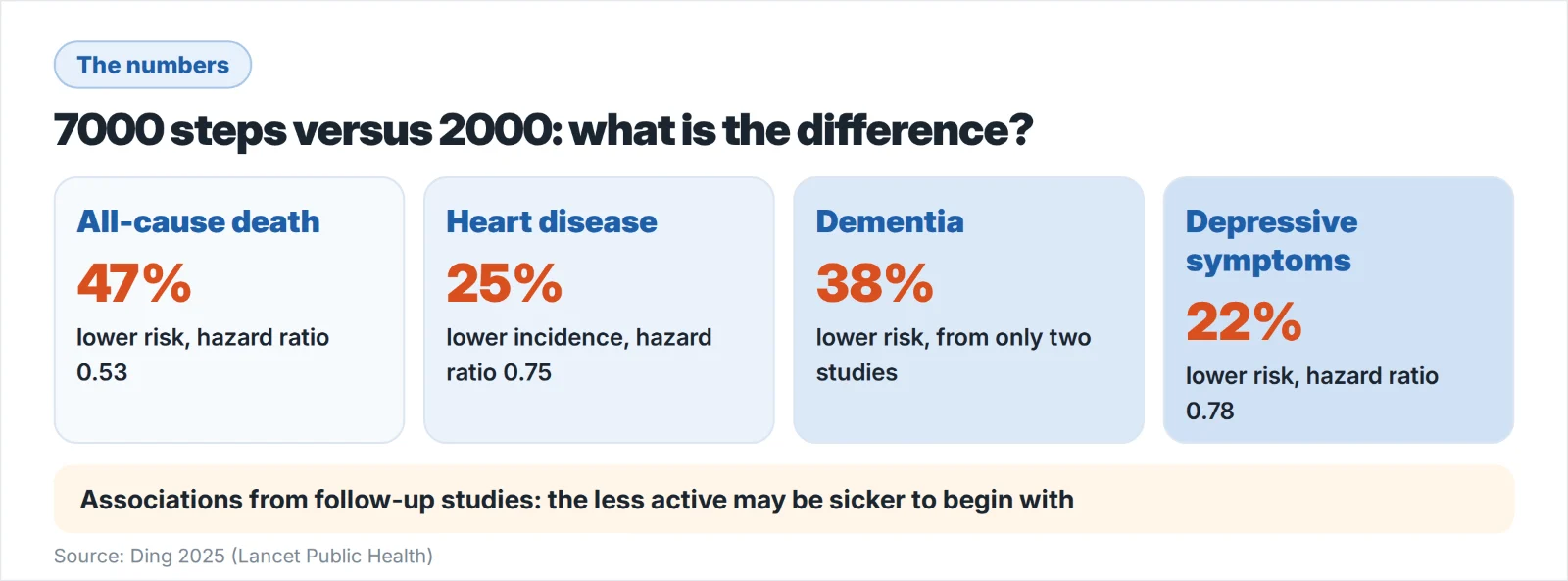
A 2025 Lancet Public Health review of 57 follow-up studies found that risk falls steeply up to about 5,000 to 7,000 steps a day: against 2,000 steps, 7,000 steps was linked to a 47% lower risk of death, 25% lower heart disease and 38% lower dementia. So 10,000 is not a magic number, and 7,000 is an easier target. Most studies are observational, so the relationship is an association, not proof, and the less active may be sicker to begin with.
The largest review: 7,000 steps versus 2,000
The 2025 Ding review in Lancet Public Health included 57 studies (from 35 cohorts), with 31 studies in the quantitative analysis, in adults measured by a device. It found an inverse non-linear association up to about 5,000 to 7,000 steps for death, heart disease, dementia and falls, and a linear one for diabetes, depressive symptoms and cancer. Compared with 2,000 steps a day:
| Outcome at 7,000 steps | Hazard ratio (95% CI) | Certainty |
|---|---|---|
| All-cause death (14 studies): 47% lower | 0.53 (0.46 to 0.60) | Moderate |
| Heart disease: incidence (6 studies): 25% lower | 0.75 (0.67 to 0.85) | Moderate |
| Heart disease: death (3 studies): 47% lower | 0.53 (0.37 to 0.77) | Low |
| Cancer: death (3 studies): 37% lower | 0.63 (0.55 to 0.72) | Moderate |
| Cancer: incidence (2 studies): 6% lower (not significant) | 0.94 (0.87 to 1.01) | Low |
| Type 2 diabetes (4 studies): 14% lower | 0.86 (0.74 to 0.99) | Moderate |
| Dementia (2 studies): 38% lower | 0.62 (0.53 to 0.73) | Moderate |
| Depressive symptoms (3 studies): 22% lower | 0.78 (0.73 to 0.83) | Moderate |
| Falls (4 studies): 28% lower | 0.72 (0.65 to 0.81) | Very low |
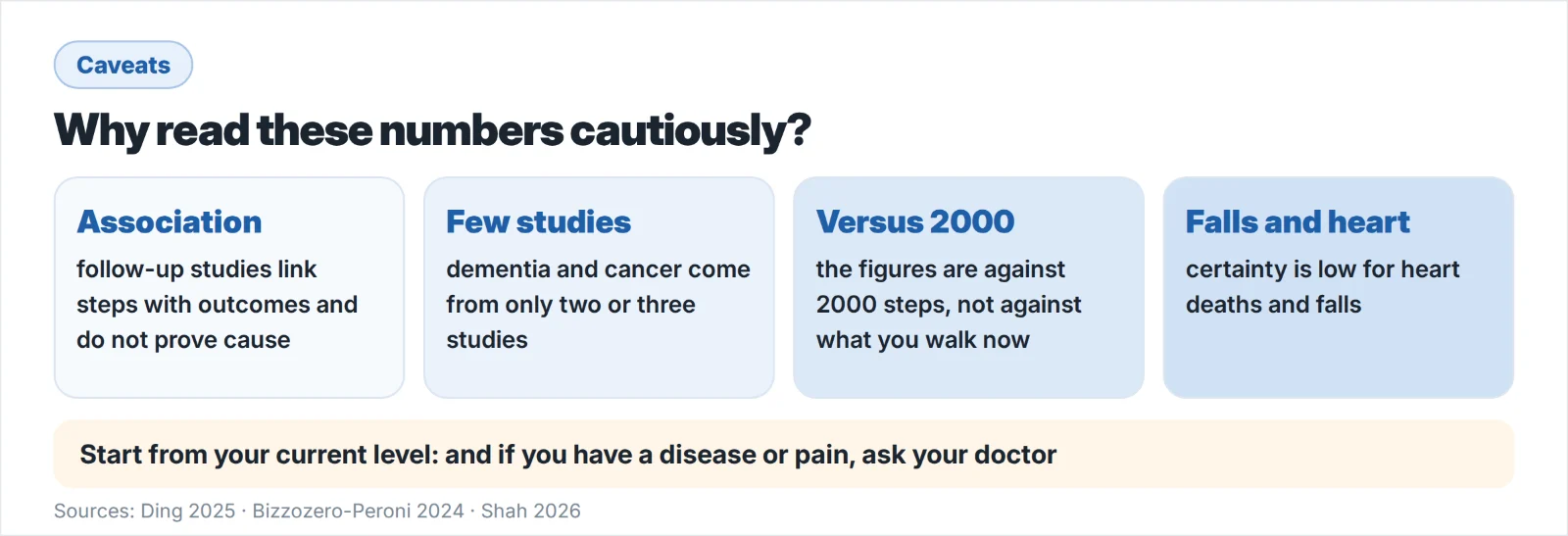
- The target: the authors wrote that 10,000 steps is a fine target for the more active, and that 7,000 steps is linked to meaningful improvement and may be an easier target for many.
- The caveat: the number of studies is small for most outcomes (two for dementia), there is bias and uncontrolled confounding, and there is no age-specific analysis.
Depression: every 1,000 steps
The 2024 Bizzozero-Peroni review in JAMA Network Open (33 studies, 96,173 adults, mostly cross-sectional) found steps inversely linked to depressive symptoms. Compared with under 5,000 steps: 5,000 to 7,499 steps (standardised difference −0.17), 7,500 to 9,999 (−0.27) and 10,000 or more (−0.26). In follow-up studies, 7,000 steps or more was linked to lower depression risk (hazard ratio 0.69), and every extra 1,000 steps to lower risk (0.91). The authors said more follow-up studies are needed. And the relationship may run both ways: depression itself reduces walking.
If you are over 65
The 2026 Shah review in the American Journal of Health Promotion (46 studies, 367,843 people over 65) found that every extra 1,000 steps a day was linked to a 13% lower risk of death (hazard ratio 0.87, 0.80 to 0.95), at an average of 5,694 steps, with the same benefit regardless of walking pace. The benefits appeared in mortality, disease, hospitalisation, cognition, psychological and functional outcomes.
What to do
- Start from your level: the big figures in the studies are against 2,000 steps; if you walk 3,000 today, add 1,000, not 10,000.
- A 7,000 target: the reviews say it is linked to clear benefits and is easier than 10,000.
- No set pace is needed: the older-adult review found the same benefit regardless of pace.
- Steps are a daily habit: along with enough sleep and hand washing in daily immunity habits, and sleep in sleep and health in Egypt.
Ask a doctor first if
- You have heart disease, high blood pressure, diabetes or pain in the knee, foot or back and plan to walk more.
- You feel chest pain, shortness of breath, dizziness or fainting while walking: stop and ask.
- You are recovering after surgery or injury.
- You are pregnant or older with a balance problem or falls.
Want to ask?
Beseha pharmacists answer on WhatsApp. Tap the “Ask a pharmacist” button and tell them your condition before you change your activity.
FAQ
How many steps a day should I walk?
The 2025 Lancet Public Health review found benefits rise quickly up to about 5,000 to 7,000 steps, and 7,000 steps was linked to a 47% lower risk of death versus 2,000; 10,000 is a fine target for the more active.
Are 10,000 steps necessary?
No; the authors wrote that 7,000 steps is linked to meaningful improvement and may be an easier target.
Does walking reduce depression?
The 2024 JAMA Network Open review found an inverse association: 7,000 steps or more with lower depression risk (0.69); but they are observational studies and the relationship may run both ways.
Is the benefit the same for older adults?
The 2026 review found every extra 1,000 steps linked to a 13% lower risk of death over 65.
Does it have to be brisk walking?
The older-adult review found the same benefit regardless of walking pace.
Is this proof?
No; they are follow-up and observational studies, and the less active may be sicker to begin with, so the result is an association.
Read next: daily immunity habits, ultra-processed foods, general health articles and general health and wellness.
The bottom line
About 7,000 steps a day is linked to a clear fall in the risk of death, heart disease, dementia and depression compared with 2,000, and the benefit rises quickly in the first 5,000 to 7,000. This is an association, not proof, so start from your level and add 1,000 steps, and ask your doctor if you have a disease or pain.
Sources
- Ding et al. 2025 (Lancet Public Health): daily steps and health outcomes, dose-response meta-analysis
- Bizzozero-Peroni et al. 2024 (JAMA Netw Open): daily step count and depression
- Shah et al. 2026: walking and health outcomes in older adults
This content is for information and is not a substitute for advice from a doctor or pharmacist. Prices and availability may change; the final price is on the product page.


