
- Your cart is empty
- Continue shopping
-
Beseha
- Posted on
- Categories:Supplements and Vitamins
- 0 comments
The 30-second answer
The Activated Black Seed Curcumin capsule has three ingredients: black seed oil 500 mg, curcumin phytosome (Meriva) 400 mg and black pepper extract 4 mg. Each has its own research: black seed in an overview of 82 studies (5,026 people), and turmeric for knee osteoarthritis in a 2026 Cochrane review (9 trials) with an effect on pain below the meaningful threshold. As for the combination, we found no published human trial on it. Black pepper can change exposure to other medicines, and turmeric has very rarely been linked to liver cases. So it is an interesting idea, not a treatment, and there is no study on the formula itself.
What is in the capsule?
#1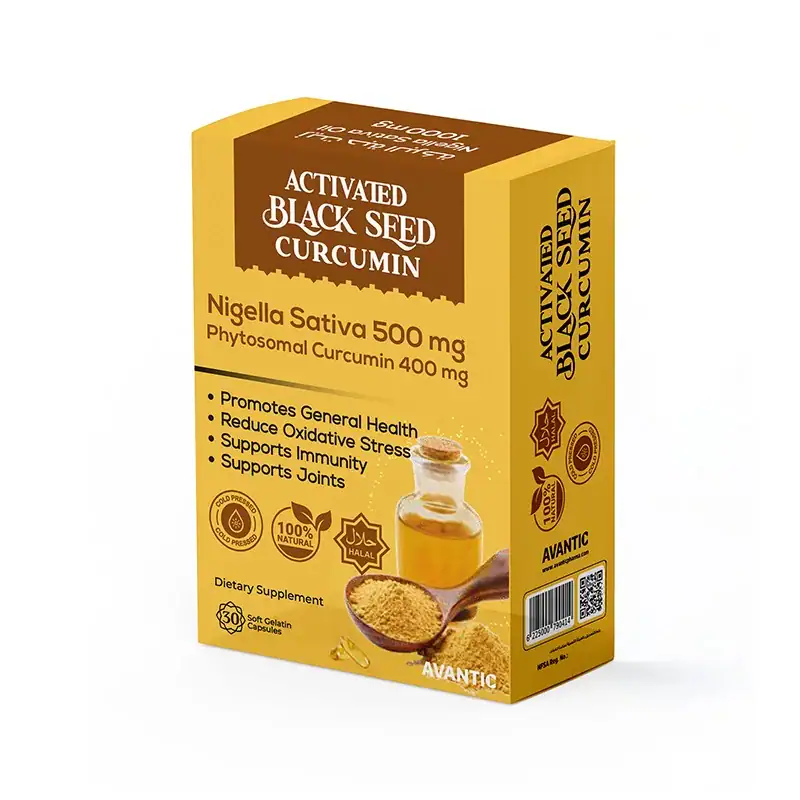
Black seed oil 500 mgMeriva 400 mg
Activated Black Seed Curcumin – 30 softgels
Three ingredients in one softgel
EGP 240
30 softgels · current price from the product page
- The page: Nigella sativa oil 500 mg + curcumin phytosome Meriva 400 mg + black pepper extract 4 mg (the piperine share is not stated)
- The page: use per the pack or as a specialist advises, with no fixed numeric dose
Heads-up: The page says it is a supplement, not a painkiller or a treatment for osteoarthritis, and there is no study on the formula. The cost is about 8 EGP a capsule. Do not stack it with another black seed product without adding up the total
| Ingredient | Amount | Note |
|---|---|---|
| Black seed oil | 500 mg | The thymoquinone share is not declared |
| Curcumin phytosome (Meriva) | 400 mg | The company spec on the page: about 18 to 22 percent curcuminoids, so about 72 to 88 mg (our calculation) |
| Black pepper extract | 4 mg | The page does not state the piperine share |
Is the combination studied?
We searched PubMed (2018 to 2026) for black seed with curcumin or turmeric in human trials and found no clinical trial on the combination. There is only a 2026 laboratory study: black seed oil bodies were used as a carrier for curcumin in test tubes, with 91 percent encapsulation and 64 percent released in simulated digestion. That is a lab, not people, and not the product formula. So any claim of a “proven synergy” is not supported by any source we opened.
Black seed in our heritage
Black seed has a place in our culture because of the hadith of Abu Huraira in Sahih al-Bukhari (5688): “In the black seed is a cure for every disease except death”, with Ibn Shihab adding that “death” is what is meant. Some scholars, such as al-Khattabi, read “every disease” as a general wording with a specific meaning. That is why it holds its place in our culture, not proof that it treats a particular condition, and not a replacement for a doctor. So what did modern research find?
What does the research say?
| Study | Type | Result |
|---|---|---|
| Jafari 2025 | A systematic review and dose-response analysis of black seed: 82 studies, 5,026 people, 1 to 48 weeks, 200 to 4600 mg a day | Better weight, blood pressure, glucose, lipid, inflammation and liver-enzyme markers; the authors call it a promising adjunct |
| Mousavi 2024 | A review of 6 trials, 370 patients with knee osteoarthritis: black seed oil | Topical oil beat placebo in 3 trials, oral oil helped in 1 of 2 and capsules showed no difference; conflicting results |
| Huseini 2022 | A trial of 116 people (50 to 70): 7.5 mL of oil a day for a month | Pain fell 34 percent versus 9 percent with placebo; the dose is far above the product capsule |
| Shirinsky 2026 (Cochrane) | 9 trials, 1245 people with knee osteoarthritis: turmeric or curcuminoids, up to 3 months | Pain gap 0.72 out of 10 (below the 1.5 threshold) and better overall treatment success (191 versus 107 per thousand); low-certainty evidence |
| Zhang 2025 | A network analysis of 39 trials, 4599 patients: 7 supplements for knee osteoarthritis | Boswellia ranked highest, curcumin helped in some outcomes, and no supplement raised side effects |
| Chen 2026 | A network analysis of 131 trials, 9,191 people with fatty liver: herbs | Curcumin lowered liver stiffness (−0.76), and the authors named black seed among the most consistent; results varied |
| Rafiee 2026 | A trial of 60 fatty liver patients: curcumin 500 mg with piperine 5 mg, 12 weeks | No difference from placebo in liver enzymes, lipids or liver fat |
| Shojaei 2025 | A trial of 70 migraine patients: phytosomal curcumin 250 mg a day, 8 weeks | Attack severity, duration and frequency fell versus placebo, on top of usual treatment; a small trial |
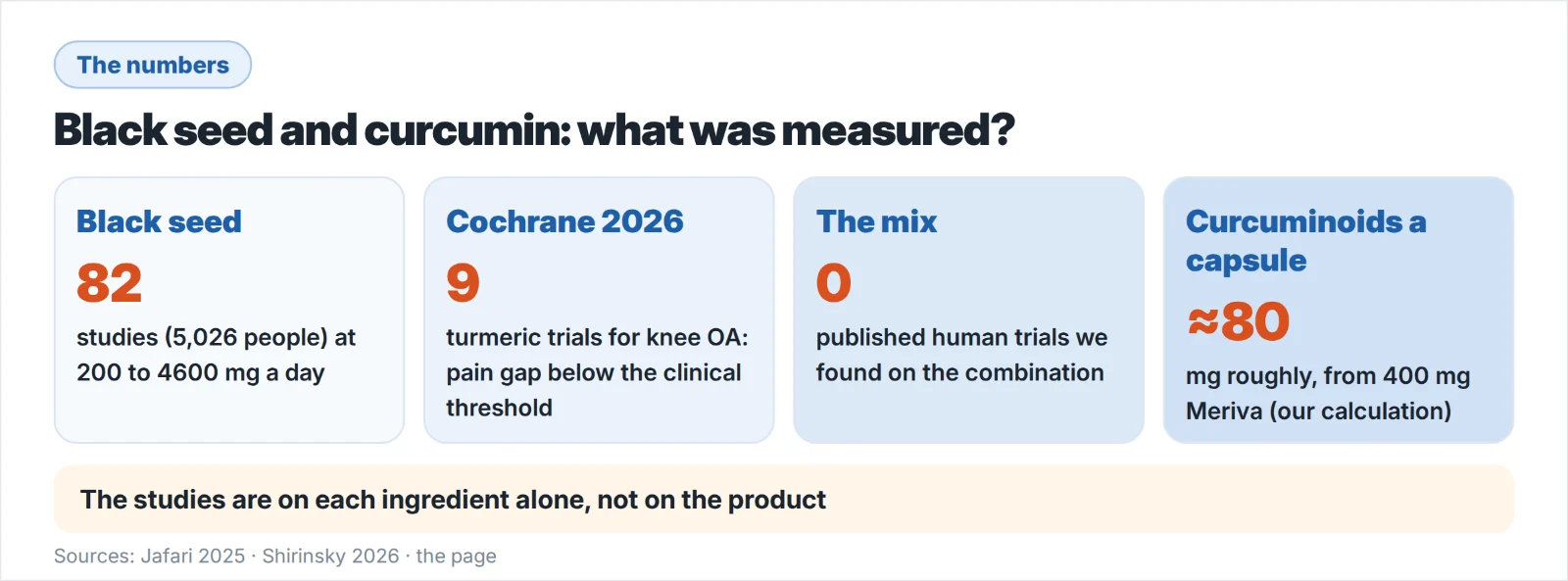
- No study on the combination or the product; the evidence is on each ingredient alone.
- Joints: the 2026 Cochrane result for turmeric is small, black seed capsules did not differ in the review, and the successful trial used a far higher dose.
- Curcumin: a small migraine trial helped, and the fatty liver trial (with piperine) did not.
- Black seed: the evidence on heart and metabolic markers is stronger, at 200 to 4600 mg a day.
- We opened no source on pregnancy, breastfeeding or children with curcumin, so ask a doctor.
Safety: what you should know
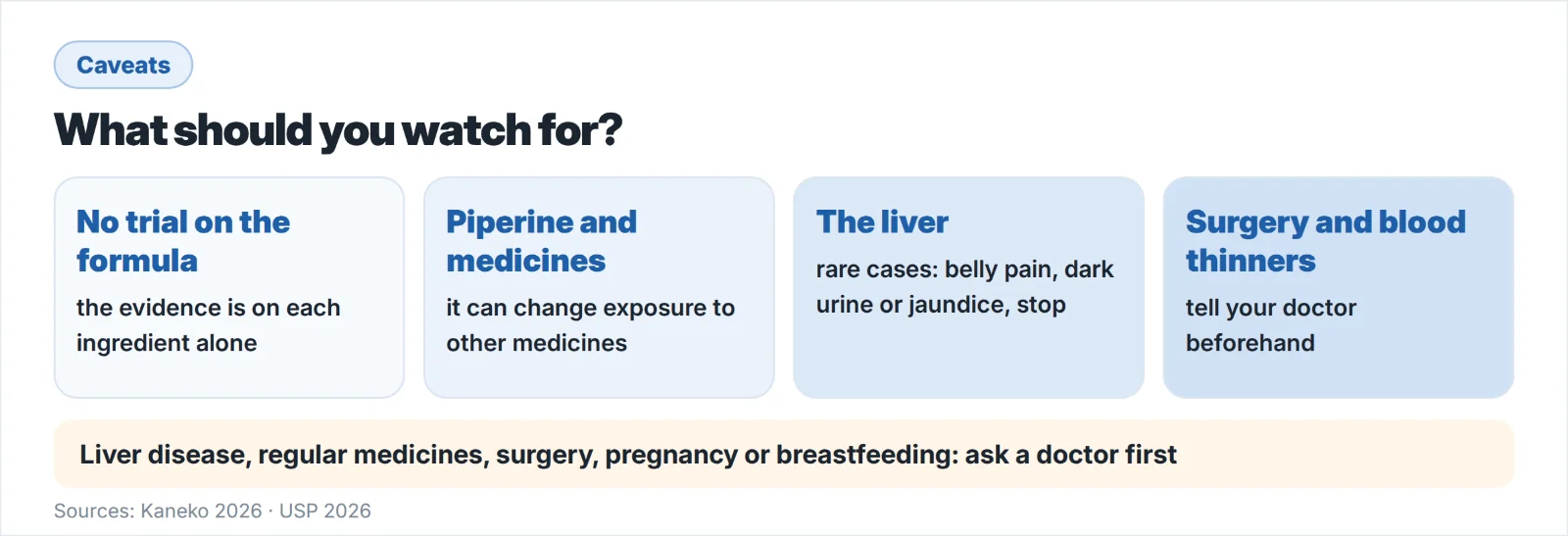
- Black pepper (piperine): a 2026 perspective summarised 22 human studies and found it raises exposure to other medicines by inhibiting liver enzymes (CYP3A4 and CYP2C9) and the P-gp transporter, and that trials without manufacturer funding did not confirm better curcumin absorption at supplement doses. The product page states 4 mg of black pepper with no piperine share.
- The liver: a 2026 USP review found very rare liver injury cases with turmeric and curcumin, usually after 1 to 4 months and resolving on stopping, and recommends a caution: ask a doctor with a liver history, and stop if belly pain, dark urine or jaundice appears.
- Bleeding and surgery: one case report of bleeding after eyelid surgery with curcumin, with causation unconfirmed; and in the lab, black seed thymoquinone reduced warfarin breakdown, with a predicted interaction risk above 1 g of oil a day (laboratory data). Tell your doctor before any surgery and if you take blood thinners.
- Pregnancy, breastfeeding and children: evidence is thin (one or two studies of curcumin in pregnancy), so ask a doctor.
Use and cost
- The dose: the page gives no numeric dose, so rely on the pack or your doctor, and do not double it.
- With food: the page says food may ease the stomach.
- Duration: trials ran 8 weeks to 3 months for turmeric, and 1 to 48 weeks for black seed.
- The cost: about 8 EGP a capsule (our calculation from the price and pack).
- Not a painkiller: do not expect a difference from the first capsule (the page).
Who should ask the doctor first?
- You take blood thinners (warfarin or others) or diabetes or blood pressure medicines.
- You have liver or kidney disease, or a history of liver injury with any supplement.
- You are pregnant or breastfeeding, or the person is under 18.
- You have surgery coming up (stop in advance as your doctor says).
- Belly pain, dark urine, jaundice, bruising, bleeding or a rash appears: stop and see a doctor at once.
Want to ask?
Beseha pharmacists answer on WhatsApp. Tap the “Ask a pharmacist” button and tell them your medicines before you start.
FAQ
Is there a study on black seed with curcumin?
We found no published human trial on the combination (a PubMed search, 2018 to 2026). There is only a 2026 laboratory study.
Does the capsule treat joint osteoarthritis?
No. A 2026 Cochrane review found a small effect of turmeric on pain, black seed capsules did not differ in a 2024 review, and the page says it is not a treatment.
What is the difference from Activated Black Seed 1000 mg?
The first has 500 mg of oil with 400 mg Meriva and 4 mg black pepper, and the second only 1000 mg of oil (per their pages).
Is the black pepper useful?
A 2026 perspective says better absorption is not confirmed in independent trials and it can change exposure to other medicines. Ask a doctor if you take medicines.
Does curcumin harm the liver?
Very rare cases were recorded (USP 2026), usually improving on stopping. Ask a doctor if you have a liver history.
How many capsules a day?
The page gives no numeric dose: per the pack or your doctor.
Read next: black seed: what the research says, turmeric and curcumin for joints and the liver and black seed for joint pain and osteoarthritis and Curcumin phytosome (Meriva): what is it? and Piperine with curcumin: absorption or risk?.
The bottom line
Activated Black Seed Curcumin combines ingredients with separate research: black seed for heart and metabolic markers, and turmeric with a small effect on knee osteoarthritis. The combination is not studied in people, and black pepper, the liver and medicines are points your doctor should know. It is a supplement, not a treatment, and there is no study on it.
Activated Black Seed Curcumin at Beseha →
Sources
- Jafari et al. 2025: black seed, a systematic review and dose-response meta-analysis
- Shirinsky et al. 2026 (Cochrane): Curcuma longa or its active ingredients for osteoarthritis
- Zhang et al. 2025: supplements for knee osteoarthritis, a network meta-analysis
- Mousavi et al. 2024: Nigella sativa in osteoarthritis
- Huseini et al. 2022: oral Nigella sativa oil for knee osteoarthritis
- Chen et al. 2026: herbal products for MASLD, a network meta-analysis
- Rafiee et al. 2026: curcumin-piperine in fatty liver
- Shojaei et al. 2025: phytosomal curcumin in migraine
- Kaneko 2026: black pepper extract in dietary supplements
- Akhtar et al. 2026 (USP): turmeric, curcuminoids and the liver
- Hosseini et al. 2026: black cumin oleosomes as a curcumin carrier (in vitro)
- Wang et al. 2022: thymoquinone and warfarin (laboratory)
- Rodrigues da Cunha 2026: a case report of bleeding with curcumin
- Activated Black Seed Curcumin product page at Beseha
This content is for information and is not a substitute for advice from a doctor or pharmacist. Prices and availability may change; the final price is on the product page.


