
- Your cart is empty
- Continue shopping
-
Beseha
- Posted on
- Categories:Immunity and Digestion
- 0 comments
The 30-second answer
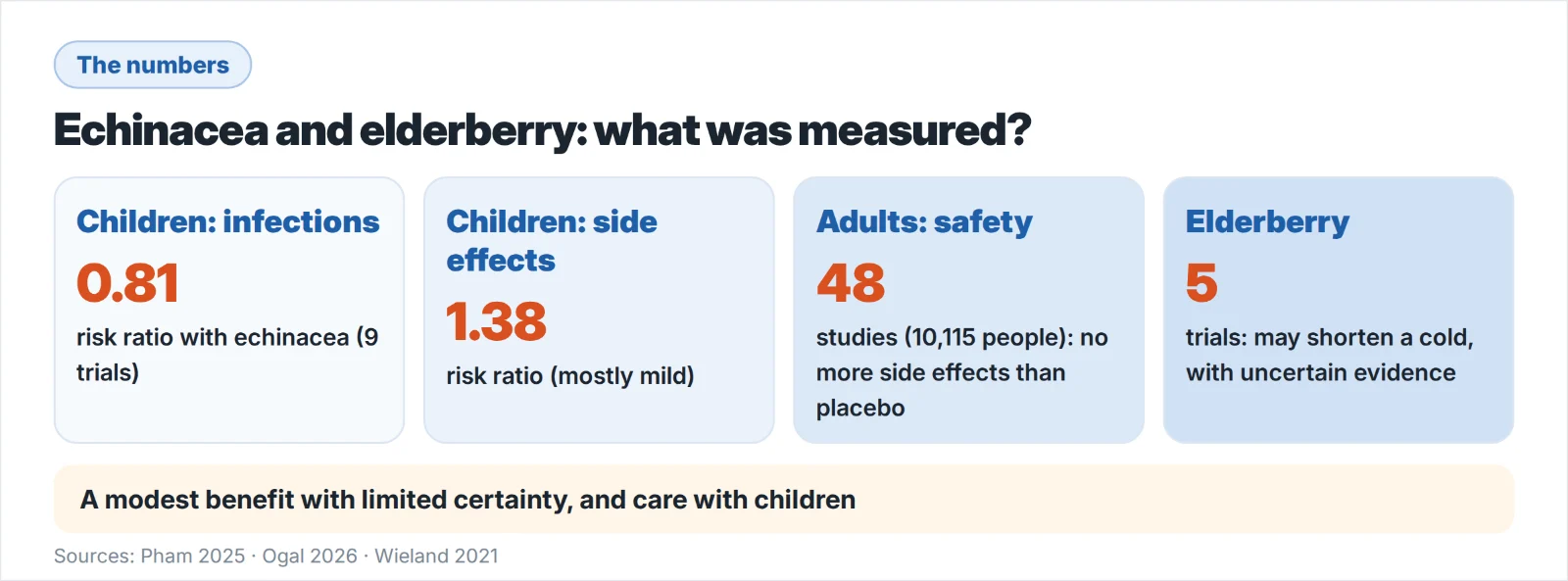
Echinacea and elderberry have a modest benefit with limited certainty. A 2026 overview of 18 reviews found echinacea and black elderberry were among a few herbs that showed some benefit in respiratory infections, but the data are insufficient for a strong recommendation. And an analysis of 9 trials in children found echinacea lowered upper respiratory infections (risk ratio 0.81) but raised side effects (1.38). Our two pages do not state the echinacea amount or extract type, and there is no study on the two products.
Two products: what do the pages say?
#1
Vitamin C, elderberry, echinacea and zinc60 ml syrup
Gemaberry Syrup – 60 ml
A four-ingredient blend in a syrup
EGP 100
60 ml syrup · current price from the product page
- The page: vitamin C, black elderberry, echinacea and zinc, by Gema Pharma, 60 ml
- The page: the dose per the pack or your doctor, shaken before use
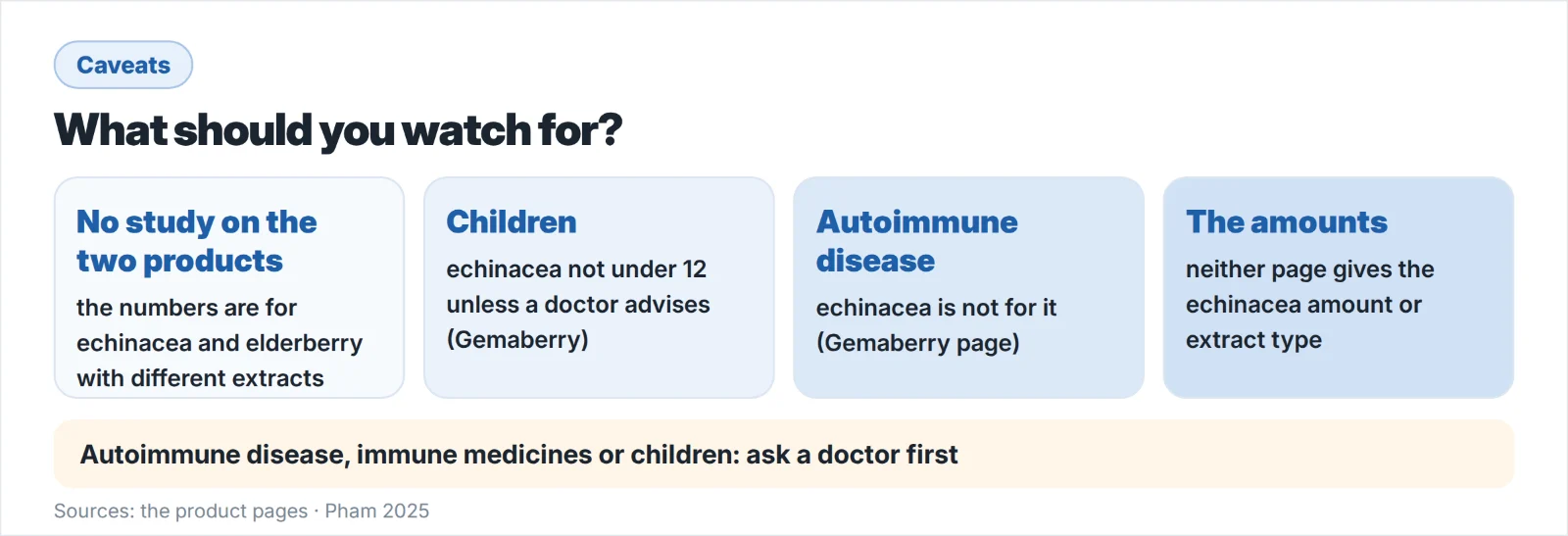
Heads-up: The page gives no amount for any ingredient. There is a conflict: the description says it suits children, while the summary says echinacea is not for under 12 unless a doctor advises and not for autoimmune disease. It contains an artificial sweetener
#2
EchinaceaCapsules
NOW Echinacea – capsules
A single ingredient with no blend
EGP 999
capsules · count not stated · current price from the product page
- The page: an echinacea herbal supplement, for adults, in capsules
- The page: with meals, do not exceed the dose, and ask a professional
Heads-up: The page gives no echinacea amount, plant part, extract type or capsule count, so we calculated no cost, and it is the more expensive. The reviews say preparations differ in effect
What does the research say?
| Study | Type | Result |
|---|---|---|
| Aghajafari 2026 | An overview of 18 systematic reviews on 16 herbs | Ginseng, ivy leaf, echinacea, eucalyptus and black elderberry showed some benefit in respiratory infections, and the rest was insufficient; a modest benefit and data insufficient for a strong recommendation; and no serious adverse events, but likely underreported |
| Pham 2025 | 9 trials in children: Echinacea purpurea | It slightly cut treatment duration (effect size 0.19), upper respiratory infections (risk ratio 0.81) and antibiotic use (0.18), and lowered otitis media episodes (0.56) without shortening treatment; but side effects rose (1.38, mostly mild) and safety is unclear |
| Ogal 2026 | 48 studies, 10,115 participants: safety of oral echinacea | Fewer adverse events with echinacea than any control (22.7 versus 24.8 percent) and than placebo (29.1 versus 32.3), and no deaths; in prevention in healthy people no difference (21.3 versus 22.3); and pharmaceutical ethanolic extracts did best |
| Wieland 2021 | 5 trials of elderberry in viral respiratory illness | It may not reduce the risk of getting a cold, may shorten its duration and severity but with uncertain evidence, and may shorten influenza; and no evidence it overstimulates the immune system |
| Crawford 2022 | 39 trials, 8 ingredients (including echinacea, elderberry, zinc and vitamin C) in healthy people | Some studies point to a benefit, but gaps in the evidence prevent firm statements |
- No study on the two products, and preparations differ in effect.
- The benefit: modest, and most evidence is on specific pharmaceutical preparations, not any capsule.
- Elderberry: it may shorten a cold, with uncertain evidence.
- Children: a possible benefit in one analysis, but side effects rose, and the Gemaberry page itself holds back under 12.
- We opened no source on echinacea in pregnancy, breastfeeding or with particular medicines, so ask a doctor.
Cost
Our calculation from the current prices and the page data (not from a study). The daily dose is not on either page, so we only compared the pack price:
| Product | Pack | Cost |
|---|---|---|
| Gemaberry | 60 ml syrup | 100 EGP per bottle, about 95 each in the 3-pack and about 90 each in the 6-pack |
| NOW Echinacea | capsule count not stated | not calculated |
How to use it
- Gemaberry: the dose per the pack or your doctor, and shake the bottle before use (the page).
- NOW Echinacea: with meals, and do not exceed the dose (the page).
- Not daily without a reason: the studies used echinacea during an infection or for short periods, and we opened no long-term study.
- Not a substitute: for sleep, food, vitamin D, zinc and the other immune supplements in our articles.
- Do not combine: more than one product with echinacea or zinc on the same day.
Ask a doctor or pharmacist first if
- You have an autoimmune disease or take immunosuppressant medicines: the Gemaberry page excludes echinacea.
- The syrup is for a child: echinacea is not for under 12 unless a doctor advises (the Gemaberry page).
- You are pregnant or breastfeeding, or allergic to plants of the daisy family (such as chamomile).
- You take regular medicines or have a chronic condition.
- A rash, difficulty breathing or facial swelling appears after a dose: stop and seek emergency care, and if cold symptoms worsen or last more than a week ask a doctor.
Want to ask?
Beseha pharmacists answer on WhatsApp. Tap the “Ask a pharmacist” button and tell them your medicines before you start.
FAQ
Does echinacea prevent colds?
A modest benefit: an analysis of 9 trials in children found fewer upper respiratory infections (risk ratio 0.81), but a 2026 overview says the data are insufficient for a strong recommendation.
Does elderberry ease a cold?
It may shorten its duration and severity, but the certainty is uncertain per a 2021 review.
Is it safe?
A 2026 review of 48 studies found adverse events lower than or equal to placebo in adults, with no deaths. In children side effects rose (1.38), mostly mild.
For children?
The Gemaberry page says echinacea is not for under 12 unless a doctor advises, so ask a doctor first.
Which product should I choose?
There is no study on either, and neither page gives the echinacea amount or extract type. Gemaberry is a cheaper blend with a conflicting description for children, and NOW Echinacea is a single, more expensive ingredient.
How many days should I take it?
We opened no long-term study, and the studies used it during an infection or for short periods. Ask a pharmacist.
Read next: immune supplements: what the evidence shows, vitamin C for immunity and zinc supplements in Egypt.
The bottom line
Echinacea and elderberry have a modest benefit with limited certainty, and the effect depends on the preparation. Our two pages give no amount or extract type, so ask a pharmacist before buying, and for children and autoimmune disease ask a doctor. And there is no study on the two products.
NOW Echinacea at Beseha → Gemaberry Syrup at Beseha →
Sources
- Aghajafari et al. 2026: herbal medicines for acute respiratory infections, an overview of systematic reviews
- Pham et al. 2025: Echinacea purpurea in children, a meta-analysis
- Ogal et al. 2026: safety of oral echinacea preparations
- Wieland et al. 2021: elderberry for viral respiratory illnesses
- Crawford et al. 2022: select supplement ingredients for the immune system in healthy people
- Gemaberry product page at Beseha
- NOW Echinacea product page at Beseha
This content is for information and is not a substitute for advice from a doctor or pharmacist. Prices and availability may change; the final price is on the product page.


