
- Your cart is empty
- Continue shopping
-
Beseha
- Posted on
- Categories:Kids' Health
- 0 comments
The 30-second answer
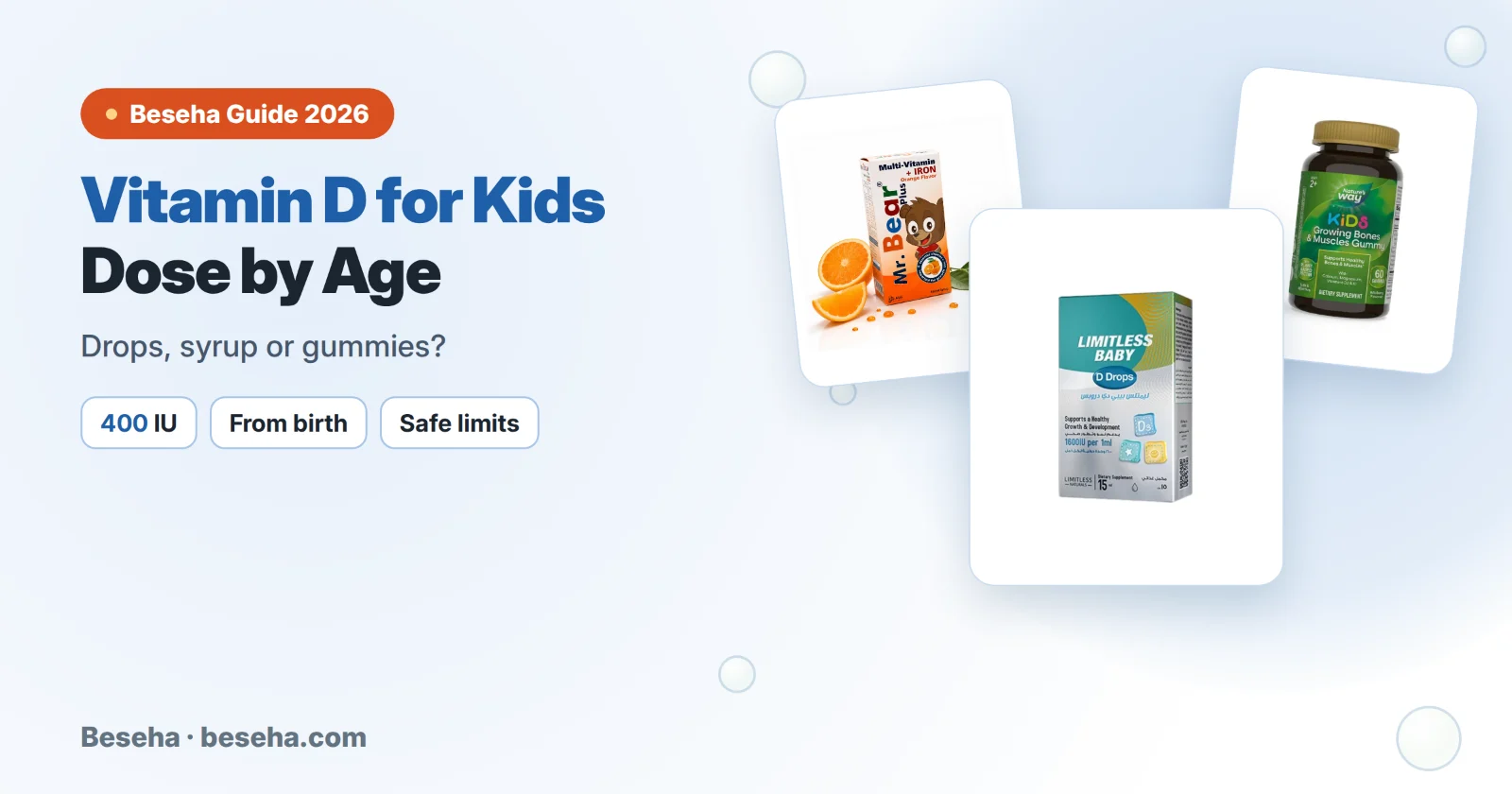
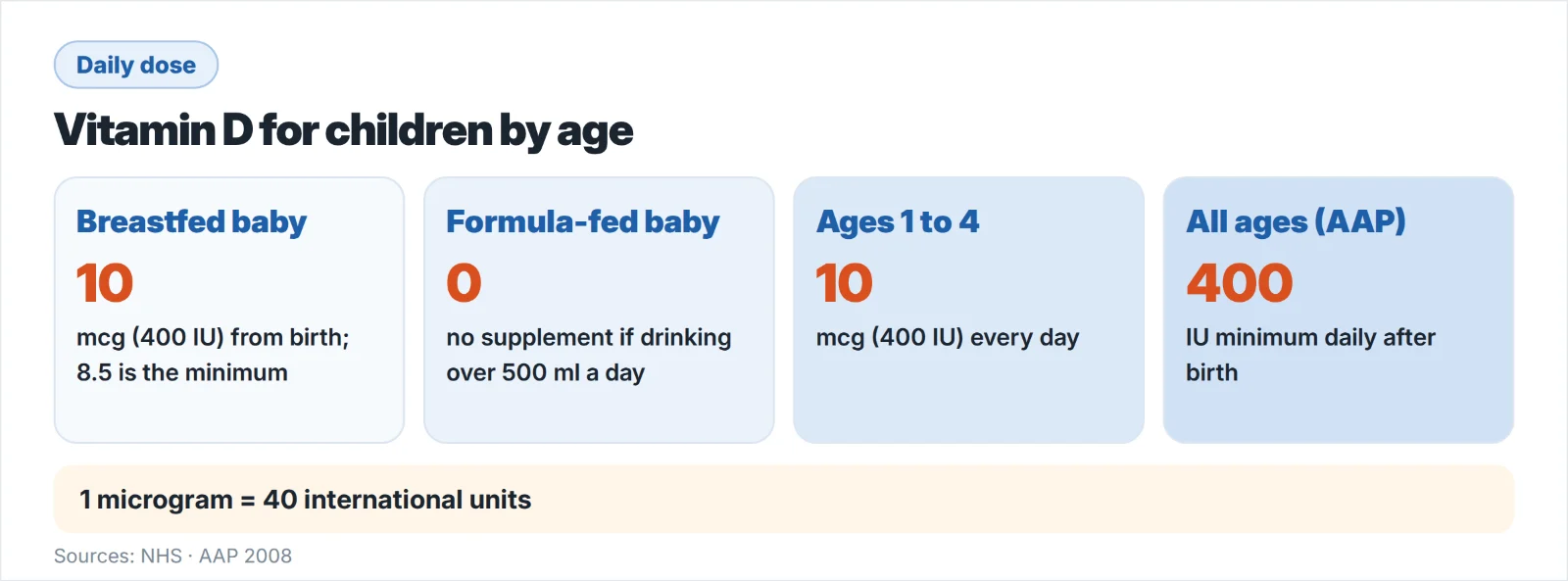
The NHS recommends 8.5 to 10 micrograms of vitamin D a day for breastfed babies from birth, 10 micrograms (400 IU) for children aged 1 to 4, and no supplement for babies drinking over 500 ml of formula a day. The simplest and cheapest option is drops: Limitless Baby D Drops at EGP 53 (a quarter dropper = 400 IU). Do not raise the dose: the limit under 1 year is 25 micrograms.
The right dose by age
- Breastfed babies: 8.5 to 10 micrograms a day from birth, whether or not the mother takes vitamin D (NHS).
- Formula-fed babies: no supplement if drinking over 500 ml a day, because formula is fortified (NHS).
- Ages 1 to 4: 10 micrograms a day (NHS).
- American Academy of Pediatrics (AAP): all infants, children and adolescents should have at least 400 IU a day, starting soon after birth.
- Conversion: 1 microgram = 40 international units, so 10 micrograms = 400 IU.
- If your doctor prescribed a different dose (for example to treat a deficiency), follow the doctor and do not change it yourself.
The upper limit: do not overdo it
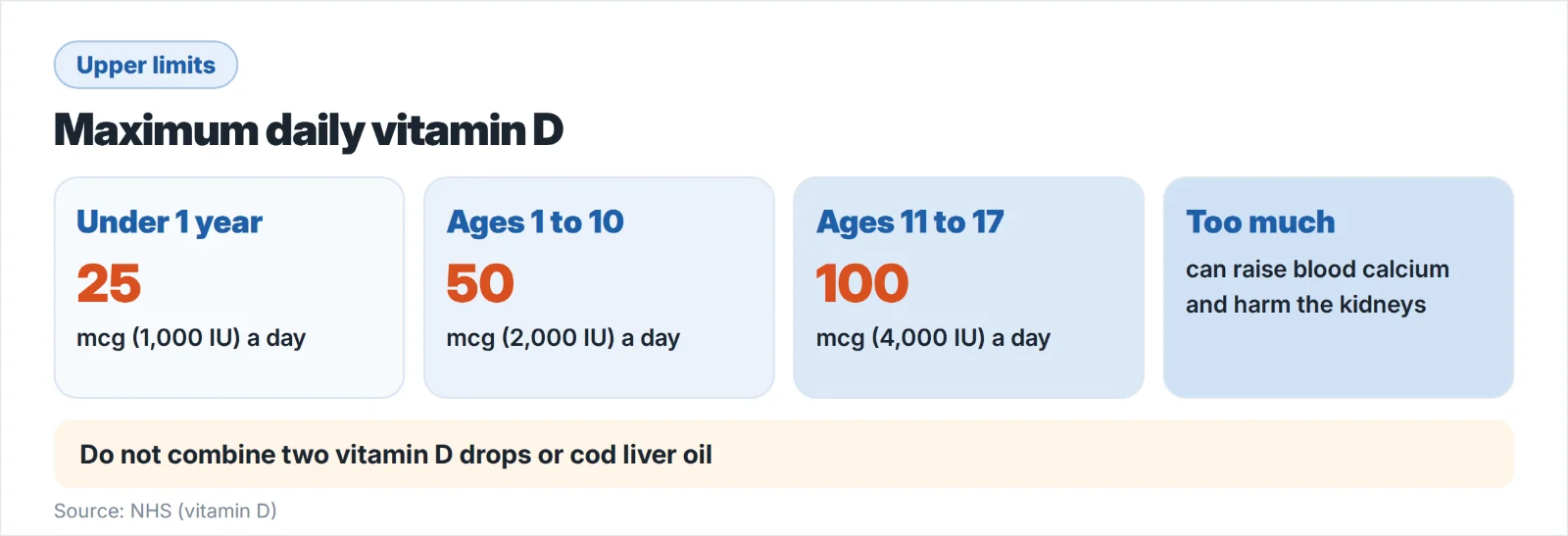
The NHS says too much vitamin D over a long period can build up calcium in the body (hypercalcaemia), which can weaken bones and damage the kidneys and heart. The daily maximum is 25 micrograms (1,000 IU) under 1 year and 50 micrograms (2,000 IU) from 1 to 10 years. It also warns against giving two supplements together or cod liver oil with drops, because cod liver oil also contains vitamins A and D.
Sunlight alone is not enough for young children per the NHS, and skin needs protection: kids’ sunscreen.
Products available at Beseha
We have one dedicated vitamin D drop for children, a syrup and gummies that include D among other nutrients, and an Egyptian calcium syrup. Pick one only and do not combine them.
#1
400 IU per 0.25 mlVitamin D3 only
Limitless Baby D Drops – 15 ml
Vitamin D3 drops for babies and children, dosed by a quarter dropper
EGP 53
EGP 0.9 per day · 60 days
- The page and pack: 1,600 IU per 1 ml, so a quarter dropper (0.25 ml) = 400 IU (10 mcg)
- The page: give straight into the mouth or in a little milk the child finishes, once a day
- Graduated dropper; the 15 ml bottle = 60 doses
Heads-up: Do not combine it with other vitamin D drops or cod liver oil; the page says not for high blood calcium or kidney problems
#2
400 IU D per 10 mlContains iron
Mr. Bear Plus Multi-Vitamin + Iron – 160 ml
A multivitamin syrup with D among 10 nutrients
EGP 145
EGP 9.1 per day · 16 days
- The page: every 5 ml has 200 IU vitamin D, and the stated dose is 10 ml after breakfast = 400 IU
- The page: every 5 ml also has vitamin A 600 mcg, vitamin C 60 mg and iron 3.33 mg
- The 160 ml bottle = 16 days
Heads-up: It contains iron and vitamin A, so do not add another supplement without asking a pharmacist; the page does not state an age range
#3
10–20 mcg D3Calcium and magnesium
Nature’s Way Kids Gummies (Bones and Muscles) – 60 Gummies
Gummies for ages 2 and up, with calcium and vitamin K1
EGP 1,790
EGP 59.7 per day · 30 days
- The pack: ages 2 to 3, 1 gummy a day (10 mcg D3 and 162 mg calcium)
- The pack: ages 4 and up, 2 gummies a day (20 mcg D3 and 325 mg calcium)
- The pack: not for under 2 because of choking; 60 gummies = 30 days at age 4+
Heads-up: The age 4+ dose has 20 mcg, twice the 10 mcg the NHS recommends but under the 50 mcg limit; it also has 4 g added sugar per dose
#4
Calcium + D3K2 and B12
EGY Pedical Plus Syrup – 100 ml
An Egyptian syrup with calcium and vitamin D3
EGP 65
EGP 0.7 per ml · 100 ml
- The page: calcium, vitamin D3, K2 and B12 to support bones
- The page: dose per the leaflet or your pharmacist, especially for children
- Strawberry flavour, 100 ml
Heads-up: The vitamin D amount is not on the page, so I cannot count it toward the daily limit; ask a pharmacist before combining with D drops
| Product | Vitamin D per dose | Price | Per day |
|---|---|---|---|
| Limitless Baby D Drops – 15 ml | 400 IU (quarter dropper) | EGP 53 | EGP 0.9 |
| Mr. Bear Plus Multi-Vitamin + Iron – 160 ml | 400 IU (10 ml) | EGP 145 | EGP 9.1 |
| Nature’s Way Kids Gummies (Bones and Muscles) – 60 Gummies | 400 IU (1 gummy, ages 2–3) / 800 IU (2 gummies, 4+) | EGP 1,790 | EGP 29.8–59.7 |
| EGY Pedical Plus Syrup – 100 ml | Not on the page | EGP 65 | — |
Ask your paediatrician or pharmacist first if
- Your child takes any other supplement or cod liver oil: the NHS says one is enough.
- There are kidney problems or high blood calcium: the drops page says not to use them.
- There is repeated vomiting, severe constipation, unusual sleepiness or excessive thirst: this may come from too much D, see a doctor (per the product page).
- The doctor prescribed a treatment dose: follow it instead of the prevention dose.
- Your child is under 2 and you want to give gummies: the pack says no because of choking.
Not sure which one?
Beseha pharmacists answer on WhatsApp. Tap the “Ask a pharmacist” button and tell them your child’s age, how they are fed and any supplement they take.
FAQ
How much vitamin D does a baby need?
Per the NHS: 8.5 to 10 micrograms a day for a breastfed baby from birth, and no supplement if drinking over 500 ml of formula a day. The AAP recommends at least 400 IU a day.
How many IU is 10 micrograms?
One microgram equals 40 IU, so 10 micrograms equals 400 IU.
Is sunlight enough for a child?
The NHS says young children should still have vitamin D drops even if they get sun, and their skin must be protected from burning.
What is the maximum daily dose of vitamin D?
Per the NHS: 25 micrograms (1,000 IU) under 1 year, and 50 micrograms (2,000 IU) from 1 to 10 years.
Can I combine drops with cod liver oil or a multivitamin?
No; the NHS warns against giving two supplements together because cod liver oil also contains vitamins A and D, and one supplement with the recommended dose is enough.
When should I see a doctor?
For repeated vomiting, severe constipation, unusual sleepiness or excessive thirst, or if the doctor prescribed a different treatment dose.
Read next: kids’ immunity vitamins by age and vitamin D deficiency in Egypt.
The bottom line
A breastfed baby needs 400 IU (10 micrograms) a day from the first day, and drops are the simplest because the dose is a quarter dropper. Choose one supplement with a known dose, do not combine two, stay under the upper limit, and let your paediatrician decide if a deficiency needs treatment.
Kids growth and immunity supplements at Beseha →
Sources
- NHS: Vitamins for children
- NHS: Vitamin D
- Wagner and Greer 2008: AAP, prevention of rickets and vitamin D deficiency
This content is for information and is not a substitute for advice from a doctor or pharmacist. Prices and availability may change; the final price is on the product page.


