
- Your cart is empty
- Continue shopping
-
admin
- Posted on
- Categories:Body and Skin Care
- 0 comments
The 30-second answer
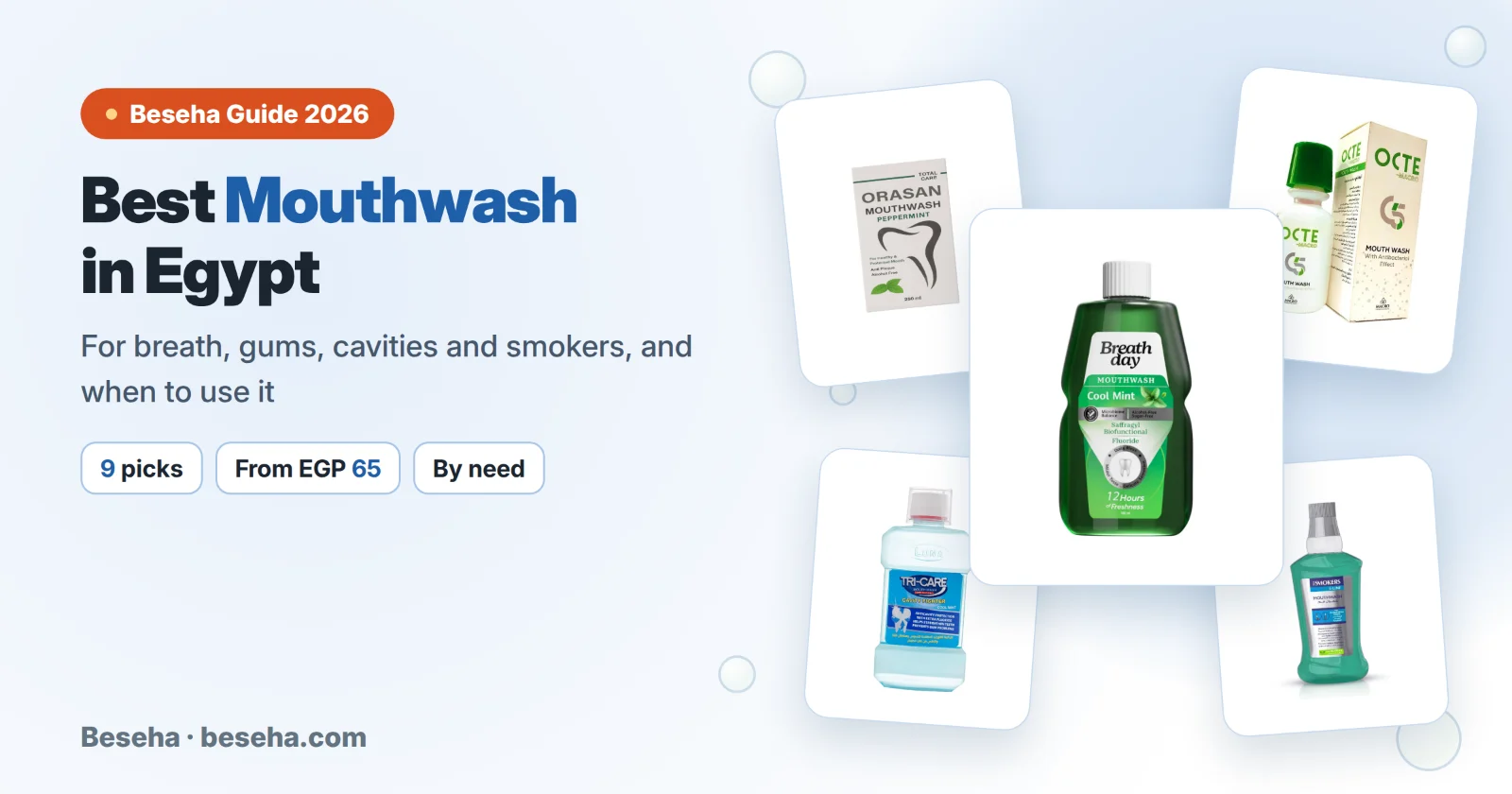
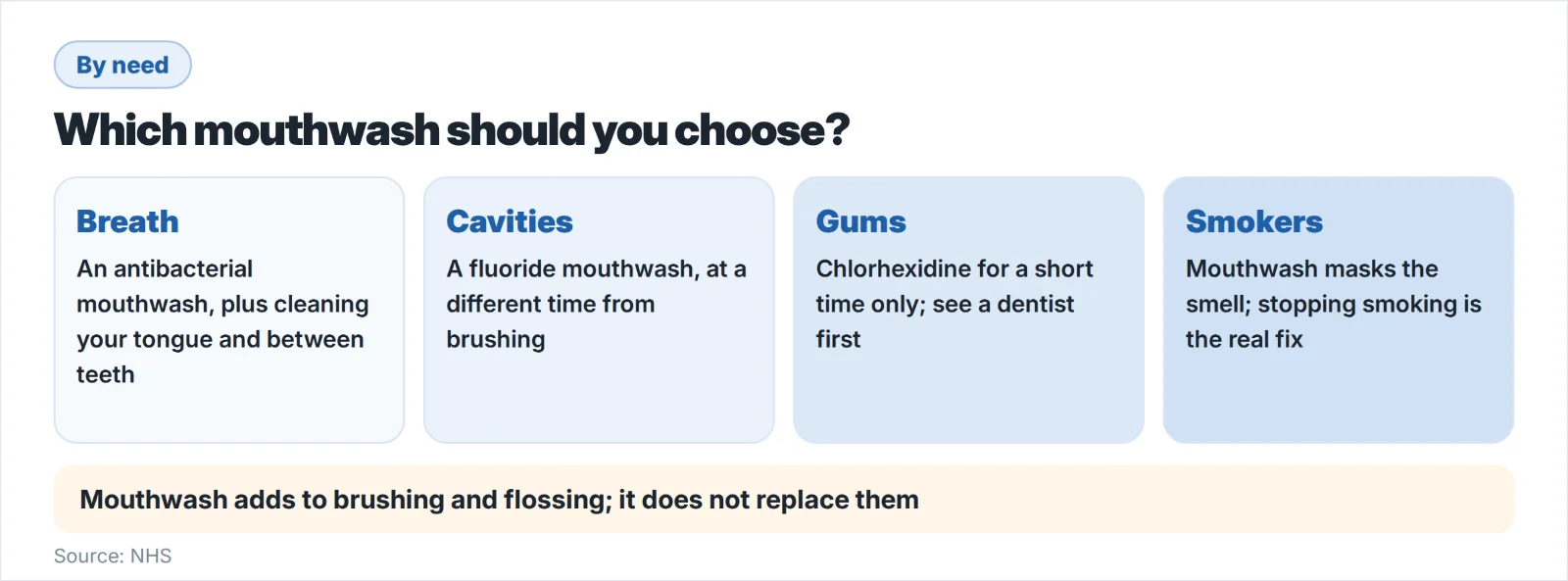
Mouthwash adds to brushing and flossing; it does not replace them. For cavities, choose one with fluoride such as Breath Day at EGP 105 or Luna Tri-Care at EGP 80, and use it at a different time from brushing. For gums and plaque, chlorhexidine such as Orasan at EGP 65, but only short term because it stains teeth. If your gums bleed or bad breath lasts weeks, see a dentist, per the NHS.
What mouthwash does and does not do
- Fluoride: the NHS says a mouthwash that contains fluoride can help prevent tooth decay.
- Bad breath: the same source suggests an antibacterial mouthwash or toothpaste, along with brushing twice a day for 2 minutes, cleaning your tongue once a day and cleaning between your teeth.
- Causes of bad breath: strong-smelling food and drinks, tooth and gum problems, fasting or crash diets, dry mouth, acid reflux and smoking.
- Gums: the NHS says gum disease is caused by plaque build-up, and early treatment means better cleaning, including between teeth, a hygienist clean and stopping smoking.
- Toothpaste: the basis is a fluoride toothpaste; see our guide to DG Dental Guard toothpaste.
For cavities and daily use: fluoride mouthwash
#1
FluorideAlcohol freeBest daily pick
Breath Day Mouthwash Cool Mint – 300 ml
A daily rinse with fluoride, no alcohol or sugar
EGP 105
EGP 0.3 per ml · 300 ml
- The pack says it contains fluoride and is alcohol and sugar free
- The pack says a milder taste and 12 hours of freshness
- EGP 105 for 300 ml
Heads-up: Use it at a different time from brushing, and do not eat or drink for 30 minutes after, because of the fluoride
#2
Extra fluorideAlcohol freeBest value
Luna Tri-Care Cavity Fighter Mouthwash – 250 ml
The cheapest mouthwash with fluoride
EGP 80
EGP 0.3 per ml · 250 ml
- The pack says zero alcohol, with extra fluoride for cavity protection
- The pack says it helps strengthen teeth and prevent gum problems
- EGP 80 for 250 ml
Heads-up: The pack says Tri-Care, not Tree Care as on the page; the same fluoride rule applies: keep it apart from brushing
For gums and plaque: chlorhexidine, short term
- How long: the NHS says chlorhexidine dental treatments are usually used for up to 4 weeks, because longer use can stain teeth.
- Side effects: stained teeth and a discoloured tongue, which go when you stop; and a mild burning or odd taste at first that improves.
- Toothpaste: the same source says toothpaste can stop chlorhexidine working properly, so use it at a different time, or rinse with water and wait at least 5 minutes.
- The usual dose: 10 ml twice a day, rinse for about 1 minute and spit, do not swallow, and no food or drink for 30 minutes.
#3
Chlorhexidine + fluorideAlcohol freeCheapest
Orasan Mouthwash – 250 ml
The cheapest mouthwash with chlorhexidine
EGP 65
EGP 0.3 per ml · 250 ml
- The page lists chlorhexidine, sodium fluoride, clove extract, thymol and menthol
- The pack says anti-plaque and alcohol free, in peppermint or clove
- EGP 65 for 250 ml
Heads-up: Chlorhexidine can stain teeth and tongue temporarily; use it short term on a dentist’s advice. The page says after brushing, but the NHS says use it at a different time
#4
ChlorhexidineAntiseptic
Verolex Antiseptic Mouthwash – 200 ml
An antiseptic rinse for gum care
EGP 70
EGP 0.3 per ml · 200 ml
- The page lists chlorhexidine, hydrogen peroxide, clove oil, menthol, thymol and chamomile
- The page says rinse 30 to 60 seconds and spit, once or twice a day
- EGP 70 for 200 ml
Heads-up: It contains chlorhexidine, so follow the 4-week rule unless your dentist says otherwise
For fresh breath without alcohol
#5
Alcohol freeAntibacterial
Macro Octe Mouthwash – 250 ml
An antibacterial rinse without alcohol
EGP 80
EGP 0.3 per ml · 250 ml
- The pack says antibacterial and alcohol free
- The pack says a mild taste and that it does not stain teeth
- EGP 80 for 250 ml
Heads-up: The active ingredient and directions are on the box, not the page; read them before use
#6
MiswakFresh breath
Macro Orovex Miswak Mouthwash – 250 ml
If you like the taste of miswak
EGP 85
EGP 0.3 per ml · 250 ml
- The pack says a miswak oral rinse for fresh breath
- The page says it contains miswak extract
- EGP 85 for 250 ml
Heads-up: Active ingredients are not on the page; choose it for taste and freshness
For smokers
The NHS lists smoking as a cause of bad breath and advises stopping as part of treating gum disease. These rinses mask the smell; they do not fix the cause.
#7
For smokersFluoride
Breath Day Mouthwash Smokers – 300 ml
For smokers, with fluoride and no alcohol
EGP 115
EGP 0.4 per ml · 300 ml
- The pack says for smokers, with fluoride, alcohol and sugar free
- The page says it neutralises tobacco odour
- EGP 115 for 300 ml
Heads-up: It only masks the smell; the NHS lists smoking as a cause of bad breath and says not to smoke
#8
For smokersDaily use
Macro Orovex Smokers Mouthwash – 250 ml
A cheaper smokers’ rinse
EGP 90
EGP 0.4 per ml · 250 ml
- The pack says for smokers, for fresh clean breath, daily care
- The page says it removes odour-causing bacteria
- EGP 90 for 250 ml
Heads-up: Ingredients are not on the page
#9
For e-cigarettesMenthol
Eva Smokers E-Line Mouthwash – 250 ml
For e-cigarette users
EGP 99
EGP 0.4 per ml · 250 ml
- The pack says for e-cigarette users, with menthol
- The pack says it maintains healthy gums, strengthens enamel and fights cavities
- EGP 99 for 250 ml
Heads-up: Ingredients are not on the page, and it is not clear whether it contains alcohol
Comparison table
| Product | Best for | Key ingredient | Price | Per ml |
|---|---|---|---|---|
| Orasan Mouthwash – 250 ml | Plaque, gums | Chlorhexidine + fluoride | EGP 65 | EGP 0.26 |
| Luna Tri-Care Cavity Fighter Mouthwash – 250 ml | Cavities | Fluoride | EGP 80 | EGP 0.32 |
| Macro Octe Mouthwash – 250 ml | Breath | On the box | EGP 80 | EGP 0.32 |
| Macro Orovex Miswak Mouthwash – 250 ml | Breath | Miswak | EGP 85 | EGP 0.34 |
| Breath Day Mouthwash Cool Mint – 300 ml | Breath + cavities | Fluoride | EGP 105 | EGP 0.35 |
| Verolex Antiseptic Mouthwash – 200 ml | Gums | Chlorhexidine | EGP 70 | EGP 0.35 |
| Macro Orovex Smokers Mouthwash – 250 ml | Smokers | Not stated | EGP 90 | EGP 0.36 |
| Breath Day Mouthwash Smokers – 300 ml | Smokers | Fluoride | EGP 115 | EGP 0.38 |
| Eva Smokers E-Line Mouthwash – 250 ml | E-cigarettes | Menthol | EGP 99 | EGP 0.40 |
How to use mouthwash
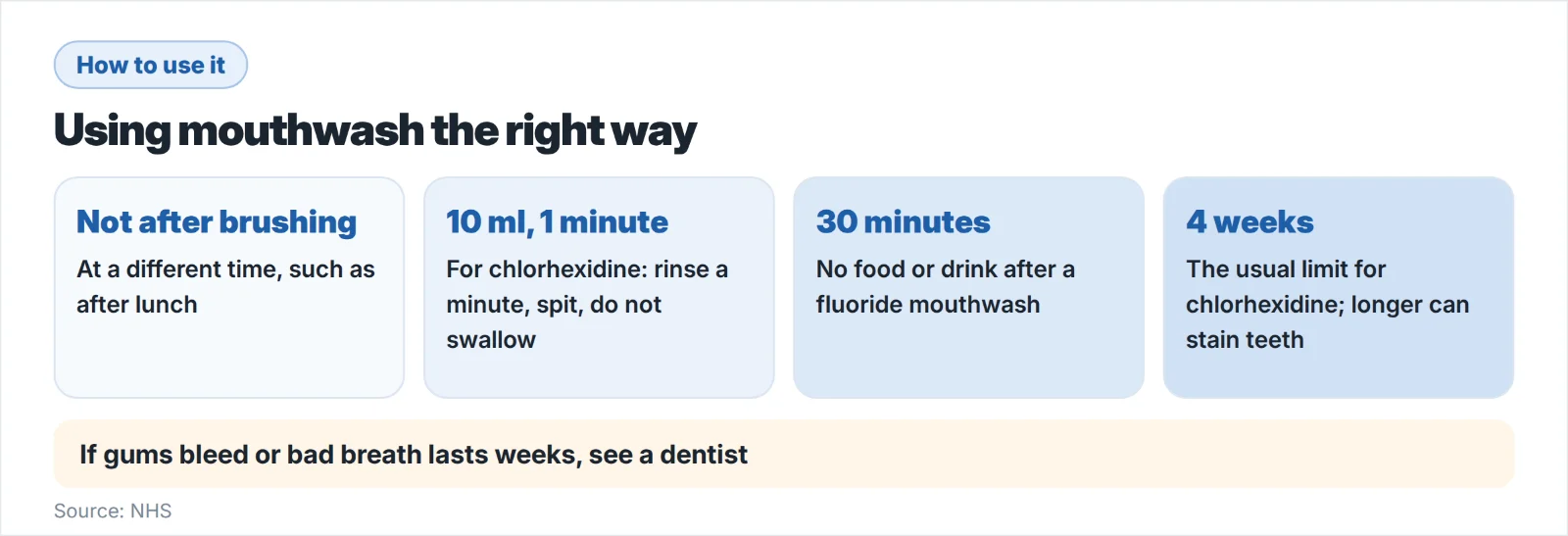
- Not after brushing: the NHS says do not use mouthwash, even a fluoride one, straight after brushing; choose a different time, such as after lunch.
- After a fluoride mouthwash: do not eat or drink for 30 minutes.
- After brushing: spit out the excess toothpaste and do not rinse, so the fluoride stays on your teeth.
- Floss: the same source says it is best to floss before brushing, or use interdental brushes.
Common mistakes
- Mouthwash instead of brushing: it does not remove plaque on its own; brushing twice a day and cleaning between teeth are the basis.
- Chlorhexidine for months: it stains teeth; use it on your dentist’s advice.
- Just masking the smell: if it lasts weeks despite cleaning, see a dentist.
- Brushing too hard: the NHS says do not brush so hard your gums or tongue bleed.
- Dry mouth? Dry mouth is a cause of bad breath; see how much water a day.
When to see a dentist
- The NHS says see a dentist if bad breath does not go away after a few weeks of home care, or your gums bleed, are painful or swollen.
- Get an urgent appointment for very sore or swollen gums, loose teeth, mouth ulcers or red patches, or a lump in the mouth or on the lip.
- Do not swallow mouthwash, and keep it out of children’s reach; if someone swallows chlorhexidine and feels unwell, get medical help.
- Routine check-ups are every 2 years for adults and every year for under-18s, per the same source.
Not sure which one?
Beseha pharmacists answer on WhatsApp. Tap the “Ask a pharmacist” button, tell them what you need it for (breath, cavities or gums) and whether you smoke, and they will help you choose.
FAQ
What is the best mouthwash in Egypt?
It depends on the goal: a fluoride mouthwash such as Breath Day or Luna Tri-Care for cavities and daily use, a chlorhexidine one such as Orasan short term for gums and plaque, and Breath Day Smokers for smokers.
When should I use mouthwash?
The NHS says not straight after brushing, even a fluoride one, but at a different time such as after lunch, with no food or drink for 30 minutes after a fluoride mouthwash.
Can mouthwash replace brushing?
No. The basis is brushing twice a day for 2 minutes with fluoride toothpaste and cleaning between your teeth; mouthwash is an extra.
Does chlorhexidine stain teeth?
Yes, stained teeth and tongue are common side effects that go when you stop. Dental treatments with it are usually used for up to 4 weeks.
What is the best mouthwash for bad breath?
The NHS suggests an antibacterial mouthwash or toothpaste, plus cleaning your tongue once a day and between your teeth. If bad breath lasts weeks, see a dentist.
Is there a mouthwash for smokers?
Yes, such as Breath Day Smokers and Orovex Smokers, but they only mask the smell; smoking itself causes bad breath and gum disease.
When should I see a dentist?
If your gums bleed, swell or hurt, or bad breath lasts after a few weeks of home care; urgently for loose teeth, mouth ulcers or lumps in the mouth.
Read next: DG Dental Guard toothpaste and how much water a day.
The bottom line
Choose by need: fluoride for cavities and daily use, chlorhexidine for gums short term on a dentist’s advice, and alcohol free if your mouth is sensitive. Use it at a different time from brushing, and see a dentist if bad breath or bleeding gums continue.
Sources
- NHS: How to keep your teeth clean
- NHS: Bad breath
- NHS: Gum disease
- NHS: How and when to use chlorhexidine
- NHS: Side effects of chlorhexidine
This content is for information and is not a substitute for advice from a doctor or pharmacist. Prices and availability may change; the final price is on the product page.


